
Vulture Spirit Animal Meaning: Necessary Endings and Transformation
~5 min read
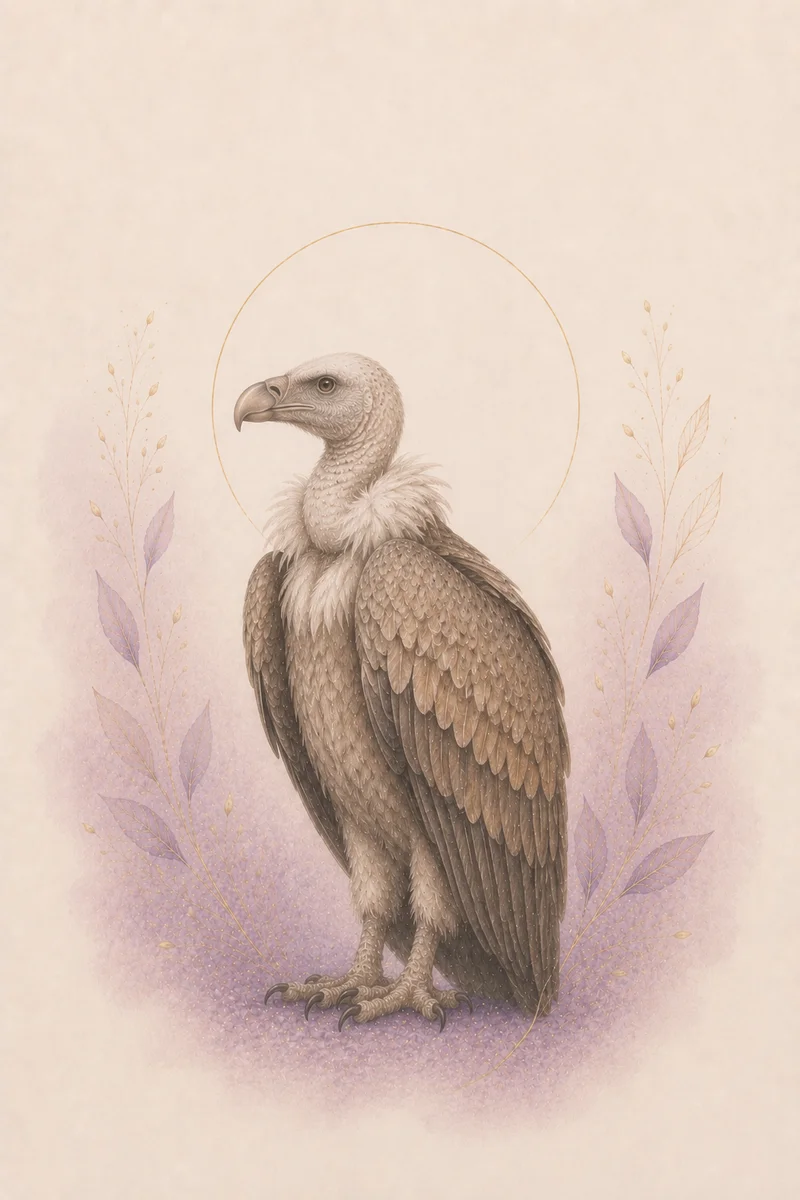
Vulture rarely gets a fair introduction. Most descriptions stop at “omen” or “scavenger” and never get any further — which skips over what the bird is actually doing while it circles: work almost nothing else is willing to do, clearing away what’s already ended before it can become a hazard to everything still alive nearby.
That’s closer to what vulture symbolism is really about — not death itself, but the necessary, unglamorous work of turning an ending into something the living can move past.
Patient closure
Ecological cleansing
Unsentimental care
Circling without release
Vulture Spirit Animal — What the Vulture Means
Vulture energy is built around finishing what’s already over — turning an ending nobody wants to look at directly into something that actually clears the way forward. Its strength isn’t in causing endings or wishing for them; it shows up only after something has genuinely finished, and does the necessary work of processing it rather than pretending it’s still alive.
That looks like a clear-eyed comfort with loss that most people instinctively flinch from, patient circling before ever moving in, and a kind of care that doesn’t announce itself with sentiment. Underneath sits a real risk: staying fixed on what’s gone long enough that the transformation never actually completes.
Real Vulture Behavior Behind the Symbol
Vultures scavenge carrion almost exclusively, feeding in a way that recycles dead matter back into the wider ecosystem rather than letting it linger as a health hazard. Many New World vulture species — turkey vultures among them — locate carcasses using an unusually strong sense of smell for a bird; Old World vultures, found across Africa and Eurasia, generally can’t smell well and instead rely on sharp eyesight and on watching where other vultures are already gathering.
An extremely acidic digestive system lets vultures neutralize many of the bacteria and toxins present in decaying flesh — turning a hazard for almost everything else into food for themselves and a genuine public-health service for everything living nearby. Vultures often roost and feed communally, and cover wide territory by riding thermal air currents, soaring for long periods while spending very little energy.
Sources on the real behavior behind this symbol: britannica.com, academic.oup.com. Full methodology and all 64 animals: see our methodology and sources.
Light and Shadow
In a healthy expression, vulture energy faces what has genuinely ended directly, and transforms it into something that actually clears the way for whatever comes next. The shadow side is subtler than it sounds: circling and picking over what’s already over without ever letting the transformation complete — staying close to a loss long after the necessary work of it is actually done.
Worth naming clearly: vulture doesn’t cause or wish for endings, it arrives after one — and processing a loss clearly isn’t the same as not caring about what was lost. This isn’t uncleanliness or menace either; vultures perform a genuinely essential ecological function, not something to recoil from.
Vulture Energy in Love, Career, and Growth
In love, this is often the one who can name clearly that something has actually ended, when the people around them are still avoiding it — worth watching for staying too long sorting through what’s already over instead of moving fully forward.
In career, it’s genuinely useful for closing out, cleaning up, or transforming what a project or team leaves behind, though it risks being typecast as only useful for endings, never for building something new.
In personal growth, it often points toward processing grief and loss directly, which can be a real strength — as long as it doesn’t turn into being unable to disengage from it.
The Inner Conflict — and Today’s Impulse
Vulture energy holds a genuine push-pull between holding on and transforming: its purpose depends on turning fully toward what’s already ended, but staying too close to that ending for too long can shift from transforming a loss into simply circling it without release. The point isn’t rushing the process — it’s letting the necessary work actually finish, and moving on once it has.
Beneath the surface, what helps most isn’t permission to feel less — it’s permission to face an ending directly without being read as cold or morbid for it, plus a clear enough sense of when the real processing is actually complete.
💭 What have you not yet let yourself fully call finished?
What is genuinely over can still become useful — but only once it’s actually let go.
Frequently Asked Questions
Is the vulture my spirit animal?
Not as a permanent label, but it can fit a time when something has truly ended. On this site spirit animal and power animal mean the same idea: an animal whose qualities mirror a current theme, not who you are forever. The vulture can be a mirror for facing a necessary ending directly and letting it become something you can move past. The Spirit Animal Quiz can show how close it feels today.
Does the vulture power animal mean something bad is about to happen?
Not primarily. Vultures don’t cause or wish for endings — they arrive after something has already finished, and their role is transforming that ending into something usable, not predicting or bringing about more loss.
What’s the difference between the vulture and the snake as power animals?
Snake’s renewal is repeated and internal — shedding what it has personally outgrown, again and again. Vulture transforms an external ending, something that already happened and finished outside itself, into something the living can move on from.
Can the vulture appear during a period of grief?
Yes — often as a sign that the real work of processing a loss is already underway, not that anything is wrong. If facing that loss directly has turned into being unable to disengage from it, it’s worth naming that concretely to a trusted person or a professional, rather than carrying it alone indefinitely.
The idea of a power animal comes from shamanic and animistic traditions found in many cultures, and is widely used today in Neoshamanism.
This page describes what the vulture means in general. Marie can help you figure out whether it’s really the vulture your current situation needs — or something else entirely.
Related Power Animals
Snake — shares the theme of letting go to allow transformation, but leans more into a repeated, internal self-renewal — shedding what it’s personally outgrown — while vulture transforms an ending that belongs to something or someone else.
Lizard — also about recovery after loss, but leans more into regenerating its own body after a personal loss, while vulture processes and transforms an ending outside itself, at that ending’s own pace.
