
Turtle Spirit Animal Meaning: Portable Safety, Patience and a Pace of Its Own
~5 min read
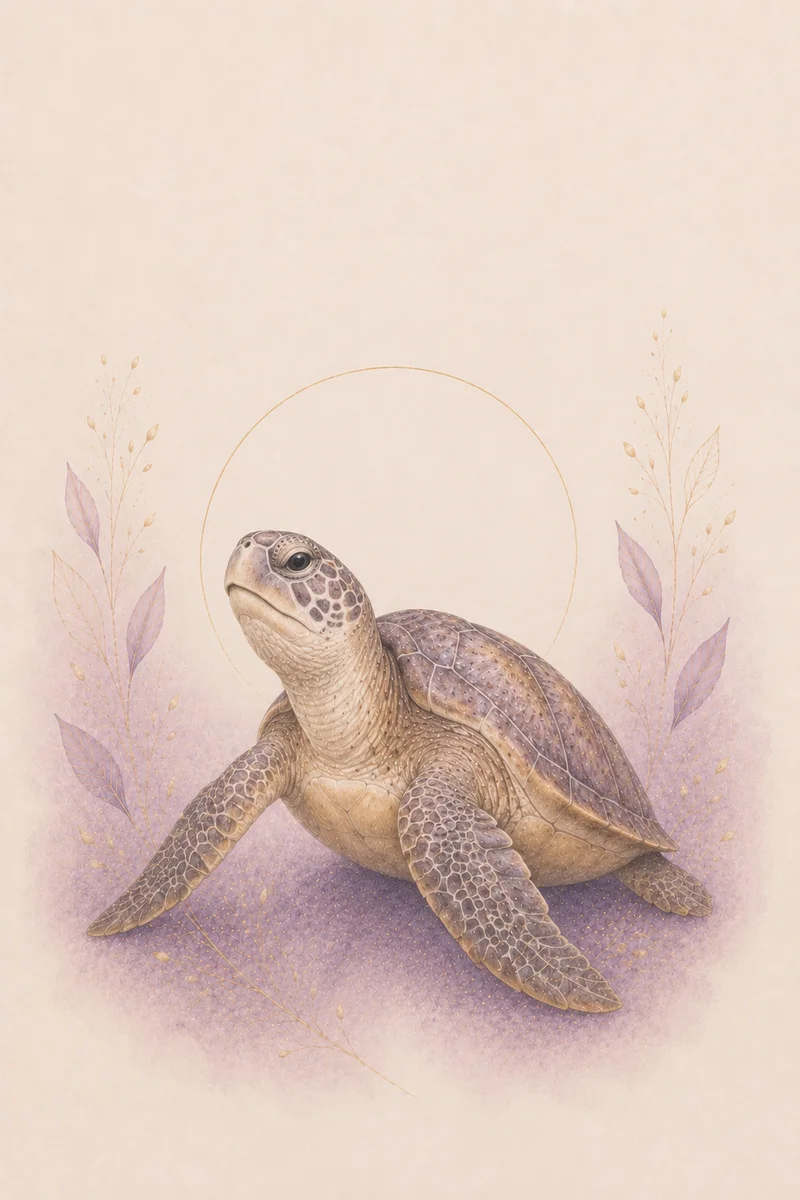
Warm stone under a shell, one leg extended and held there a moment before the next step. A turtle rarely moves like something being chased, or something waiting to be.
That unhurried pace isn’t hesitation — it’s the pace of something that already carries its own safety wherever it goes, and answers to nothing but its own readiness.
Patience
Self-contained protection
Enduring stability
Being underestimated for its pace
Turtle Spirit Animal — What the Turtle Means
At the center of turtle symbolism is a safety that never has to be found — because it’s already there, built into the body itself. A turtle’s shell isn’t equipment it puts on when trouble starts; it’s fused directly to its own spine and ribs, so protection and self are, quite literally, the same structure.
That built-in security is what makes the slow, deliberate pace turtle energy is known for possible in the first place. Patience here isn’t hesitation or fear — it’s a considered speed, chosen because the turtle already knows it isn’t in danger without moving faster.
Real Turtle Behavior Behind the Symbol
A turtle’s shell is fused directly to its spine and ribcage — an integrated part of its own skeleton, not armor it wears and could set down — and pulling its head and limbs inside it functions as a passive, built-in defense the moment a threat appears. Most turtle species are largely solitary, though some bask or nest in loose proximity to others rather than forming any real social bond.
Survival leans on that shell and on an efficient, low metabolism that, in many species, can slow dramatically to endure cold or lean stretches on very little energy. Sea turtles carry a further, striking version of this patience: several species navigate back to the exact stretch of beach where they hatched, sometimes decades earlier, to lay their own eggs there.
Sources on the real behavior behind this symbol: journals.biologists.com. Full methodology and all 64 animals: see our methodology and sources.
Light and Shadow
Lived well, turtle energy uses that built-in safety as a base to explore from — extending out into new situations at a pace that’s its own, then retreating only when something actually calls for it. The shadow side shows up as withdrawal that stops answering to any real threat at all: pulling back so often and so completely that it stops extending out, even into places that have already proven safe.
Worth naming clearly: the shell isn’t a habit to break or armor to remove — it’s a permanent part of the turtle’s own body. A slow pace isn’t laziness or avoidance either; it’s a different, sustainable speed, not a lesser one. And retreating inward, on its own, isn’t giving up — for a turtle, it’s a normal, temporary part of moving through the world.
Turtle Energy in Love, Career, and Growth
In love, this carries a stable sense of safety into closeness rather than needing a partner to provide it — worth watching for retreating out of habit even once a relationship has already proven safe.
In career, it tends to be reliable and steady over the long run, especially in work that rewards patience over speed, though it can be underestimated in fast-moving settings built around visible urgency.
In personal growth, it often points toward real, unhurried recovery time and a pace it doesn’t have to defend or explain to anyone else.
The Inner Conflict — and Today’s Impulse
Turtle energy lives with a real back-and-forth between protection and openness: it already carries real safety with it everywhere, but staying fully withdrawn inside that safety means missing the very ground it was built to move across. A constructive response isn’t forcing a faster pace — it’s extending back out gradually, trusting the shell will still be there if it needs to retreat again.
What this usually calls for isn’t more courage or more speed — it’s permission to move and decide slower than everything else seems to be moving, with the option to pull back still open.
💭 Where are you still pulling inward out of habit, even in a place that’s already safe?
A home you carry with you doesn’t need permission to move slowly.
Frequently Asked Questions
Is the turtle my spirit animal?
If you value a pace of your own and a sense of safety you carry with you, the turtle may feel close right now. Spirit animal and power animal are the same idea here: an animal whose qualities mirror a theme in your life at this moment, rather than a fixed identity. Many people read the turtle as patience that is chosen, not fearful. The Spirit Animal Quiz can show how close it feels today.
Does the turtle power animal mean I’m avoidant or afraid to engage?
Not primarily. A turtle’s slow pace is a different, sustainable speed, not fear or laziness — and its shell isn’t something it puts on defensively, it’s simply how the turtle is built. This symbolism is about a real pace, not a retreat from difficulty.
What’s the difference between the turtle and the hedgehog as power animals?
Hedgehog’s spines are a reflexive defense it’s actively learning to lower as trust builds. Turtle’s shell is a permanent, structural part of its own skeleton — protection as identity and pace, not a reflex being unlearned.
Can the turtle appear during a long period of withdrawing from other people?
Yes — often as a prompt to notice whether that withdrawal is still actually needed, or has become a habit that’s outlasted the danger it once protected against. If pulling back has settled in even around people or places that feel safe, it’s worth naming that to a trusted person or a professional, rather than assuming it will ease on its own.
The idea of a power animal comes from shamanic and animistic traditions found in many cultures, and is widely used today in Neoshamanism.
Symbols tend to mean more in conversation than they do on a page. If the turtle is asking something of you, Marie is a good place to find out what.
Related Power Animals
Hedgehog — shares the theme of protective withdrawal, but leans more into a reflexive defense it’s actively learning to lower as trust builds, while turtle’s shell is a permanent, structural part of its own body — protection as pace, not a reflex to unlearn.
Koala — also about retreat and conservation, but leans more into withdrawing to conserve limited energy from a low-nutrient diet, while turtle withdraws as a built-in structural defense, unrelated to energy scarcity.
