
Spider Spirit Animal Meaning: Patient Creation, Fine Control and Hidden Strength
~4 min read
You’ve been working on something for weeks that nobody else can see yet — one careful piece at a time, with nothing to show for it except your own certainty that it’s going to hold once it’s finished.
That patience, and that quiet confidence in an unfinished structure, is close to what spider symbolism is actually about: not menace, but precise, deliberate creation — something built thread by thread that ends up stronger than it looks.
Fine Control
Hidden Strength
Deliberate Structure
Obsessive Rechecking
Being Underestimated
Spider Spirit Animal — What the Spider Means
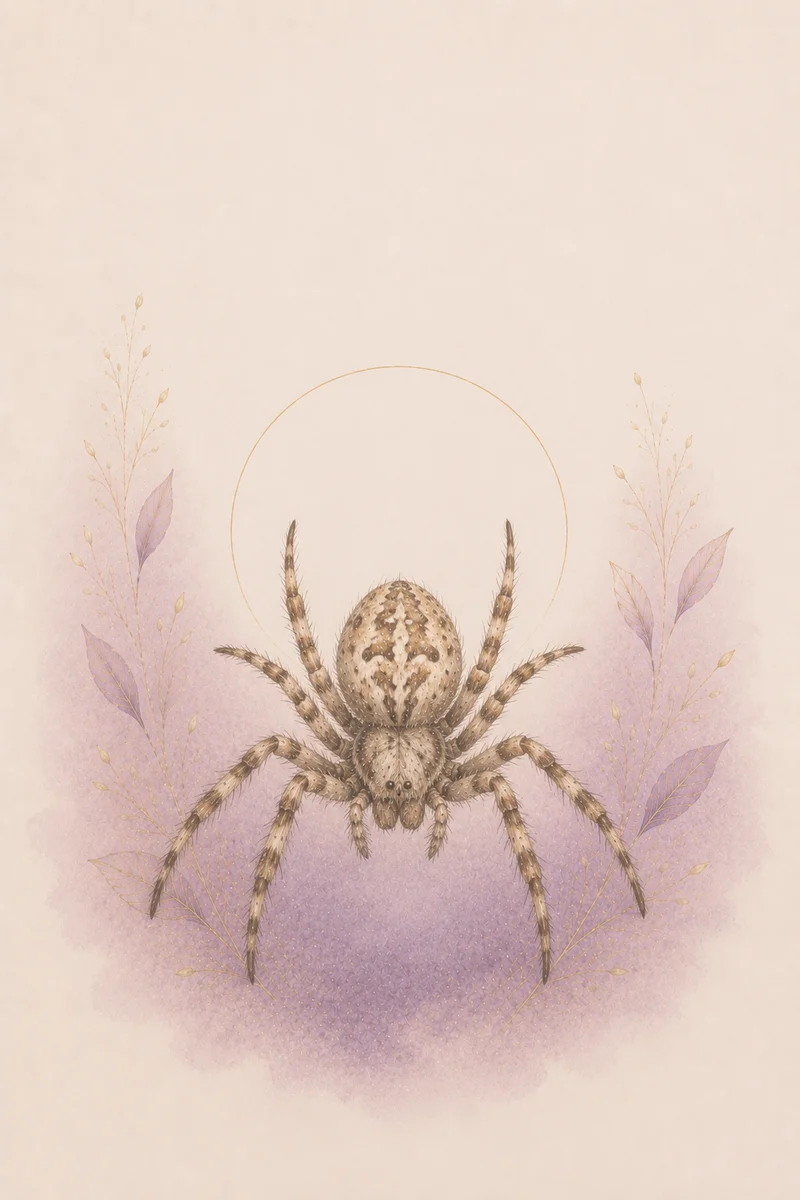
At the center of spider symbolism is something intricate, built one deliberate thread at a time, that ends up able to hold far more than its size would suggest. Its strength isn’t about size or speed — it’s about precision sustained over real time, and a willingness to keep at slow, exacting work long before there’s anything to show for it.
That shows up as real comfort with detail work that doesn’t pay off immediately, a level of control over fine, small pieces that others might not even notice, and a genuine need to feel that whatever’s being built will actually hold once it’s done.
Real Spider Behavior Behind the Symbol
Spiders spin silk — a material that, weight for weight, is stronger than steel — into precisely engineered webs, then wait at the center or nearby, reading fine vibrations through the strands to sense what’s happening at a distance. That stillness at the center of a web isn’t idle; it’s active sensing, gathering real information through touch rather than sight.
Most of the more than 45,000 known spider species are solitary, building and hunting alone rather than cooperatively, and many rebuild or repair damaged webs — some species do this daily — rather than treating a torn structure as a finished loss. Behavior varies hugely across the group the word “spider” covers, but that combination of patience and precision runs through most of it.
Sources on the real behavior behind this symbol: Mortimer et al., J. R. Soc. Interface (2016), summarized for a general audience at phys.org. Full methodology and all 64 animals: see our methodology and sources.
Light and Shadow
In its healthy form, spider energy builds patiently and precisely, then actually trusts the finished structure enough to rely on it, instead of endlessly re-checking every thread. The shadow side is a kind of control that never lets go: refining or rebuilding a structure that was already sound, or holding every detail so tightly that the work never quite counts as finished.
Worth naming clearly: none of this is menace or ill intent — spinning and waiting are ordinary survival behavior, not something aimed at anyone — and “delicate-looking” work here is genuinely, physically strong, not fragile. Stillness at the center of a web is attentive, not passive.
Spider Energy in Love, Career, and Growth
In love, this builds intimacy through patient, consistent small actions rather than grand gestures, though it can tip into controlling exactly how closeness is supposed to look.
In career, it excels at detailed, long-horizon work most people would find too painstaking, but may struggle to delegate or loosen its grip on fine details.
In personal growth, it often points toward trusting a structure once it’s actually sound, instead of needing to control it forever to believe it will hold.
The Inner Conflict — and Today’s Impulse
Spider energy holds an ongoing tension between patience and control: the same careful, exacting process that makes its creations genuinely strong can also keep it endlessly refining, never quite willing to call the work done. Letting go of a finished structure can feel riskier than continuing to check it, even once it’s already sound.
The point isn’t loosening standards or rushing the careful part — it’s learning to trust a structure once it’s actually finished, rather than needing constant control over it to believe it will hold.
💭 Where are you controlling every detail out of care, and where has it started to control you instead?
Something built thread by thread can still hold more weight than anyone expected.
Frequently Asked Questions
Is the spider my spirit animal?
You might feel a pull toward the spider while working patiently on something intricate. Here, spirit animal and power animal describe one idea: an animal whose qualities mirror a theme in your life right now, never a fixed identity. The spider can be a mirror for slow, precise creation and for hidden strength. If you wonder how close it feels, the Spirit Animal Quiz can help today.
Does the spider power animal mean something threatening or unsettling?
Not primarily. Spinning silk and waiting at the center of a web are ordinary survival behaviors, not something aimed at anyone. This symbolism is about patient, precise creation — fear-based associations say more about how spiders are usually portrayed than about what they’re actually doing.
What’s the difference between the spider and the beaver as power animals?
Beaver builds something durable and shared, reshaping a landscape with others in mind. Spider’s building is more solitary and fine-grained — precise, deliberate control over one intricate structure, made and maintained largely alone.
Can the spider appear when perfectionism or control starts feeling exhausting?
Yes — often as a prompt to notice when careful attention has tipped into a need to control everything. If that need for control feels constant and draining rather than occasional, it’s worth talking to a trusted person or a professional, rather than just pushing through it alone.
The idea of a power animal comes from shamanic and animistic traditions found in many cultures, and is widely used today in Neoshamanism.
Where do you already live this? Where are you still reaching for it? Where might you be stuck in its shadow side? Marie can help you sit with all three.
Related Power Animals
Beaver — shares the theme of deliberate building, but leans more into something durable and shared, reshaping a landscape with others in mind, while spider builds fine, intricate structure alone, for its own use.
Ant — also about patient, repeated effort, but leans more into many small contributions spread across a large, cooperative collective, while spider’s patience centers on precise, solitary control over one structure.
