
Sloth Spirit Animal Meaning: Unhurried Pace, Self-Trust and Quiet Persistence
~5 min read
What if moving slower wasn’t a delay at all, but just a different, working relationship with time? That question sits at the center of sloth symbolism, in an animal whose entire life runs on a pace the world around it keeps trying to speed up.
A sloth doesn’t rush, even while everything nearby moves fast around it. It gets where it’s going, eventually, on a timeline built specifically for its own body — and that’s exactly where its meaning as a power animal starts: trusting that timeline instead of apologizing for it.
Self-Trusted Tempo
Quiet Persistence
Deliberate Slowness
Grinding to a Halt
Mistaken for Laziness
Sloth Spirit Animal — What the Sloth Means
Sloth energy is a pace so deliberate it can only be sustained by real self-trust — the conviction that slow is not the same as behind, held steady even while people nearby insist otherwise. It isn’t reluctance, and it isn’t resistance to getting things done; it’s a genuinely different relationship with time, one where results still arrive, just on a longer, more honest timeline.
That shows up as real confidence in a pace other people don’t share, a quiet resistance to being rushed even under visible pressure, and results that outlast anyone’s doubts about how they got there. Underneath sits a real vulnerability too: when the pressure to hurry gets loud enough, for long enough, even a well-earned pace can start to feel like a flaw instead of a strategy.
Real Sloth Behavior Behind the Symbol
Sloths move with an unusually low metabolic rate and slow, minimal motion — an adaptation suited to a diet of leaves so low in calories that a single meal can take weeks to fully digest. Speed simply isn’t available to a body running on that little energy, and it isn’t needed either: stillness itself, not evasion, is a sloth’s primary survival strategy.
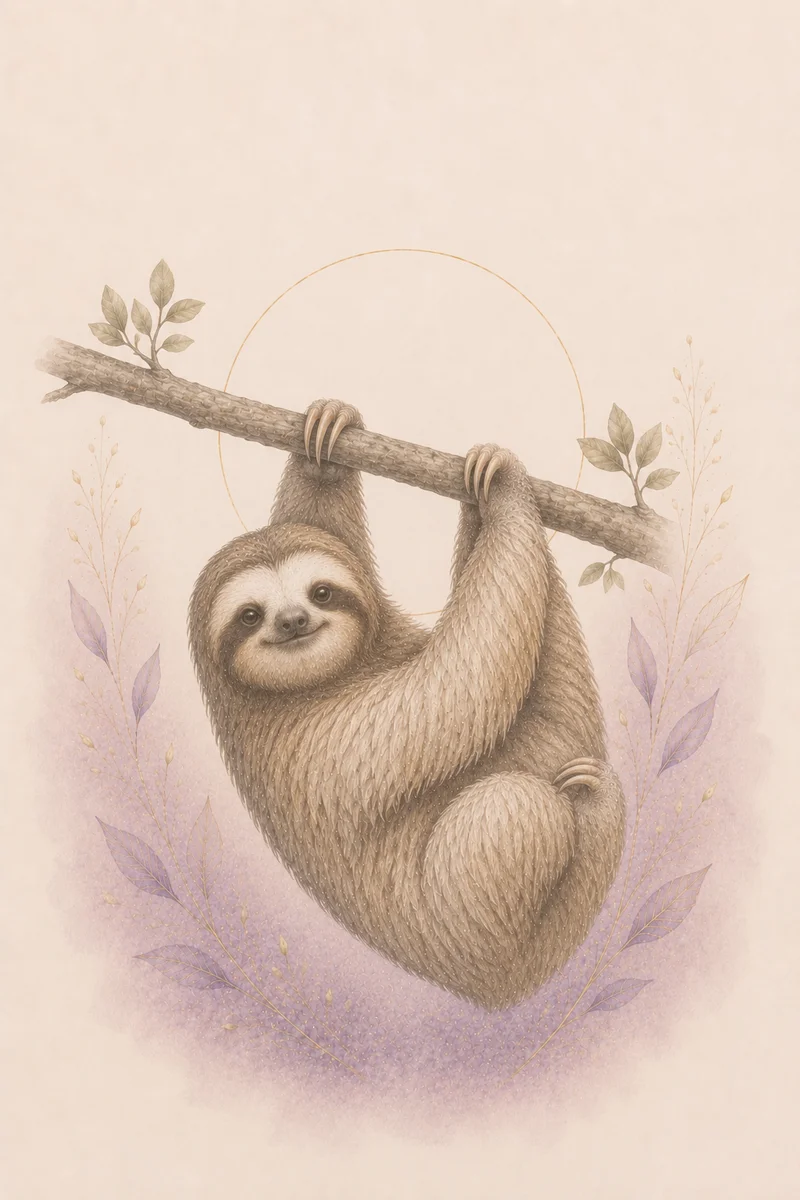
They live mostly solitary, arboreal lives, spending nearly all of their time in the forest canopy with minimal contact with others of their kind. Long, curved claws let them hang securely from branches for extended stretches without expending real muscular effort, part of how an animal built for so little energy still manages to stay up there safely for most of its life. Algae often grows directly in a sloth’s fur, tinting it faintly green and helping it blend into the surrounding leaves — camouflage built out of staying still long enough for something else to grow on top of it.
Even the descent to the forest floor, which most sloths make only rarely, happens at that same unhurried pace; there’s no sudden burst of speed held in reserve underneath it, waiting to be used if things get urgent enough.
Sources on the real behavior behind this symbol: news.mongabay.com. Full methodology and all 64 animals: see our methodology and sources.
Light and Shadow
In a healthy expression, sloth energy holds its own pace with real confidence, working steadily toward something even when none of the process looks urgent from the outside. The shadow side shows up in two different directions: either grinding to a full stop under the weight of constant pressure to speed up, or, more quietly, starting to believe its natural pace really is some kind of deficiency.
Worth naming clearly: none of this is laziness. A sloth’s slowness is a functioning strategy, not an absence of effort or intention, and it doesn’t mean an inability to act decisively when something truly calls for it — only that decisive action happens inside its own tempo, not someone else’s.
Sloth Energy in Love, Career, and Growth
In love, this builds trust and intimacy on a genuinely slower timeline than a partner might expect — and needs that timeline respected rather than read as disinterest.
In career, it produces careful, reliable work when given real time, but performs worst under artificial urgency, and can go overlooked in fast-paced environments that reward speed over care.
In personal growth, it often points toward trusting a pace that’s already working, instead of measuring itself against a speed it was never built to match.
The Inner Conflict — and Today’s Impulse
Sloth energy lives with a real back-and-forth between a pace that genuinely works and outside pressure that never quite stops questioning it. The conflict isn’t really about speed — it’s about whether slow is actually allowed, or whether it’s secretly just falling behind. Under enough sustained pressure, even a sloth confident in its own rhythm can start to wonder.
The useful shift isn’t proving the pace to anyone else — it’s proving it to itself, through what actually gets finished, on its own timeline, rather than by matching a speed it was never built for.
💭 Where are you letting someone else’s urgency override a pace that’s actually working for you?
Slow is not the same as behind.
Frequently Asked Questions
Is the sloth my spirit animal?
Possibly, if you are learning to trust an unhurried pace in a world that keeps urging you to speed up. Spirit animal and power animal mean one thing here: an animal whose qualities mirror a theme in your life right now, not a fixed identity. The sloth can be a mirror for self-trust and quiet persistence, since slow is not the same as behind. The Spirit Animal Quiz can show how close it feels today.
Does the sloth power animal mean I’m lazy or unmotivated?
Not at all. A sloth’s slowness is a functioning survival strategy shaped by an extremely low-calorie diet, not an absence of effort — real things get done, just on a longer timeline than expected.
What’s the difference between the sloth and the koala as power animals?
Koala’s stillness comes from an energy supply that’s genuinely limited — a matter of necessity. Sloth’s slowness is more about defending its own natural tempo against outside pressure to move faster than actually feels right — a matter of pace, not capacity.
Can the sloth appear when someone feels constant pressure to move faster than feels right?
Yes — often as encouragement to trust a pace that’s already working. If that pressure starts causing real distress, exhaustion, or shutdown, it’s worth naming concretely to a trusted person or a professional, rather than pushing through it alone.
The idea of a power animal comes from shamanic and animistic traditions found in many cultures, and is widely used today in Neoshamanism.
This page describes what the sloth means in general. Marie can help you figure out whether it’s really the sloth your current situation needs — or something else entirely.
Related Power Animals
Bear — shares the theme of slowness and stillness, but leans more into a temporary, seasonal retreat that alternates with real bursts of active strength, while sloth’s pace is constant and about tempo itself.
Koala — also about minimal movement, but leans more into conserving a supply of energy that’s genuinely limited, while sloth is more about defending its natural tempo against outside pressure to hurry.
