
Salmon Spirit Animal Meaning: Effort, Return and Costly Purpose
~6 min read
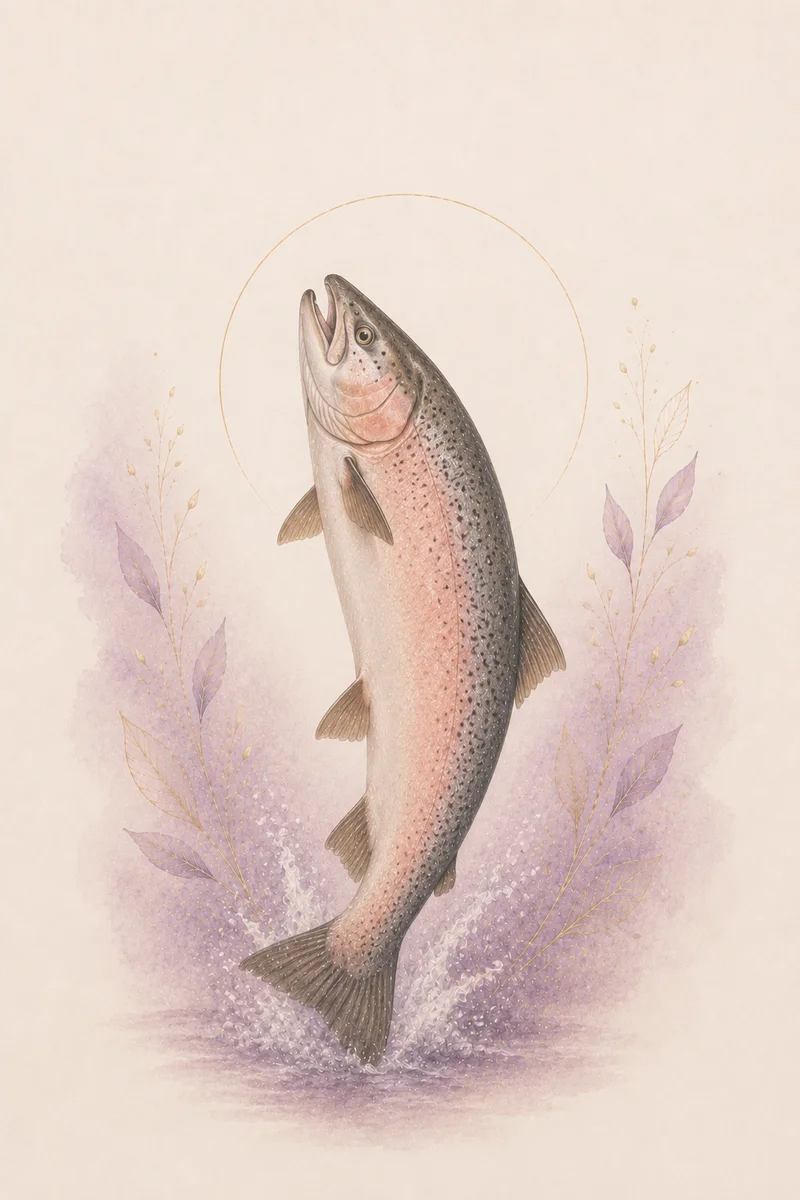
Cold water breaking white over stone, and one body pressing forward through it anyway — muscle straining, gills working hard, the current pushing back the entire time. Nothing about the moment is easy, and nothing about it lets up.
That single, costly push against real resistance, toward something that matters more than the ease of staying still, is the center of what a salmon carries as a symbol.
Determination
Costly purpose
Completion
Struggle mistaken for meaning
Salmon Spirit Animal — What the Salmon Means
Salmon energy is a single, costly push toward something that matters more than the ease of staying still — effort spent deliberately against real resistance, in service of a goal beyond immediate comfort. It commits fully to reaching one specific destination, taking on real, visible cost along the way rather than looking for an easier current to follow instead.
Underneath that drive sits a genuine tension between what the effort is actually costing and what it’s actually for — a push that doesn’t ease off just because the current is against it, but that only means something when the goal on the other end is real. That’s the part worth sitting with before assuming every hard push is automatically worth making: resistance on its own proves nothing about whether the destination deserves the cost.
Real Salmon Behavior Behind the Symbol
Salmon migrate from the ocean back to the specific freshwater stream of their birth to spawn, swimming against strong currents and leaping obstacles like rapids and waterfalls along the way. Finding that particular stream again, out of an entire coastline, relies on a remarkably precise sense of smell built around the chemical signature of the water they hatched in years earlier. They travel in large runs alongside others making the same journey, though the physical effort itself is largely individual — each fish pressing forward on reserves it built up over years spent at sea, with no opportunity to feed again once the migration itself has begun.
In many Pacific salmon species — chinook, sockeye, and coho among them — the adult dies shortly after spawning, having completed its reproductive purpose; this pattern is specific to those species, not a universal fact about every salmon. Atlantic salmon, by contrast, can survive spawning and return to sea to breed again in a later season, which is worth holding onto here: the drive to reach the goal is the constant across the species, not the assumption that everything gets spent in a single, final push.
Sources on the real behavior behind this symbol: ncbi.nlm.nih.gov. Full methodology and all 64 animals: see our methodology and sources.
Light and Shadow
In its healthy form, salmon energy pushes hard toward something genuinely worth the cost, while staying aware of what the effort is actually taking along the way. The shadow side shows up as momentum without a clear reason behind it anymore: still pushing against the current out of pure habit, past the point where the original goal still justifies what it’s costing.
Worth naming clearly: struggle alone isn’t proof a goal is worth it, and this symbolism doesn’t automatically mean total self-destruction — the drive here is toward completion, not toward harm for its own sake. Easing effort or resting mid-journey isn’t failure, either; it’s part of judging the cost honestly. A goal doesn’t earn more meaning simply because reaching it hurt more, and a salmon that pauses partway upstream hasn’t abandoned the run — it’s still moving toward the same destination.
Salmon Energy in Love, Career, and Growth
In love, this will go to real lengths for a relationship it has decided matters, showing up fully even through a genuinely hard season — worth watching for sacrificing its own wellbeing for a bond without ever weighing the actual cost.
In career, it pushes hard through a demanding, resistant phase toward a clearly defined goal, willing to sacrifice short-term comfort for something specific and significant, though it’s prone to burnout when the effort continues well past the point of diminishing return.
In personal growth, it often points toward asking honestly what a goal is actually worth, rather than just admiring how much it’s willing to sacrifice for it, and toward noticing the difference between real resolve and momentum that’s simply carrying on out of habit.
The Inner Conflict — and Today’s Impulse
Salmon’s drive pushes it to give everything toward one costly goal, but that same total commitment can outpace what it can actually afford to give. The useful shift isn’t refusing to push hard when something genuinely matters — it’s weighing what the goal is actually worth against what continuing to push is truly costing, rather than assuming full sacrifice is automatically the only valid kind of effort.
Beneath the surface, what helps most isn’t praise for how much it’s willing to sacrifice — it’s honest acknowledgment of what the effort is taking, and clarity that the goal on the other end is still real. Being admired only for the struggle, and never asked what the struggle is actually for, tends to make the pushing harder to stop even once it stops making sense.
💭 What is this effort actually costing you, and is it still worth that price?
Effort against the current only means something if you know what you’re swimming toward.
Frequently Asked Questions
Is the salmon my spirit animal?
Often, yes, during a time of committed effort toward one destination. Spirit animal and power animal are the same idea on this site: an animal whose qualities mirror a theme in your life right now, not a fixed identity. The salmon, returning to the stream where it hatched, can be a mirror for purposeful effort and for asking if the cost is worth it. The Spirit Animal Quiz can show how close it feels today.
Does the salmon power animal mean I’m heading toward self-destruction?
Not necessarily. Salmon’s drive is toward completion, not automatically toward harm — struggle alone isn’t proof a goal is worth it, and easing effort or resting partway through isn’t failure. The symbolism is about weighing real cost against real purpose, not glamorizing sacrifice for its own sake.
What’s the difference between the salmon and the crane as power animals?
Salmon’s return is a single, effortful push against real resistance, weighed against genuine personal cost. Crane’s return is a chosen, ritual devotion — the same path walked again and again across many seasons, rather than one defining push toward a fixed endpoint.
Can the salmon appear when someone is close to burning out from a long, demanding effort?
Yes — often as a prompt to check whether the goal still justifies the cost, rather than a sign to simply push harder. It can also show up near the actual finish line, when the temptation is to spend everything left rather than pace the last stretch. If ongoing self-sacrifice without real recovery has become the pattern, it’s worth naming that concretely to a trusted person or a professional, rather than carrying it alone.
The idea of a power animal comes from shamanic and animistic traditions found in many cultures, and is widely used today in Neoshamanism.
Not sure if the salmon is really your animal, or if your situation actually calls for something else? Marie can help you tell the difference.
Related Power Animals
Crane — shares the theme of return, but leans more into a chosen, ritual devotion repeated across many seasons, while salmon is more about one single, costly push weighed against real personal cost.
Whale — also shaped by a life spent in open water, but leans more into depth and distance held over a long, largely undirected span, while salmon centers on a costly, directed push toward one specific goal.
