
Parrot Spirit Animal Meaning: Voice, Connection and Becoming Your Own
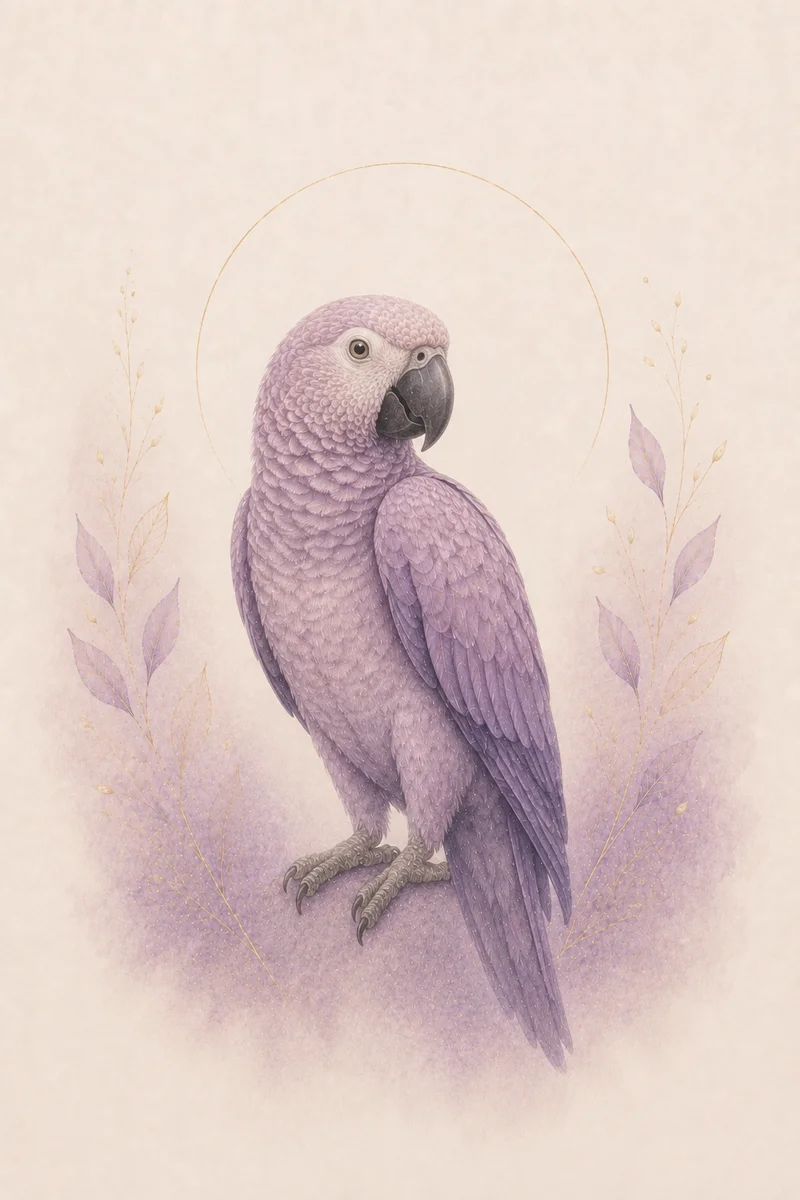
~5 min read
A parrot’s first words are never really its own. They arrive borrowed whole — a phrase, a laugh, a particular rise in tone — picked up from whoever it spends the most time with. Watch one long enough, though, and that borrowed phrase starts landing in places its original speaker never used it, worked into new moments the parrot chose for itself.
That small shift, from repeating something to actually using it, is close to what parrot symbolism is really about: a voice built through closeness to others that slowly turns into something recognizably its own.
Connection through imitation
Vocal bonding
Developing independence
Doubting what’s genuinely its own
Mistaken for shallow mimicry
Parrot Spirit Animal — What the Parrot Means
Parrot energy is a voice built first through closeness — expression that starts by picking up someone else’s words, tone, or habits, and gradually turns into something recognizably its own. It isn’t really about a lack of originality so much as one particular path toward finding it: imitation as a starting point, never meant to be the final destination.
That shows up as strong, specific bonds carried largely through voice and communication, real uncertainty at times about which parts of its own expression started with someone else, and a tendency toward open, visible speech rather than a quiet retreat inward. Underneath all of it sits a genuine pull between wanting real connection and needing a voice that’s unmistakably its own.
Real Parrot Behavior Behind the Symbol
Many parrot species are capable of true vocal learning — acquiring and reproducing genuinely novel sounds, including human speech, rather than relying only on calls they’re born already knowing. That places them among a small group of animals with this ability, alongside humans, dolphins, and a handful of other birds. Many species also use individually distinct contact calls that work much like a name, recognized by other birds within their flock.
Vocal mimicry itself appears to have evolved mainly in service of social bonding and flock cohesion, not as a kind of performance for its own sake. Alongside that vocal ability, parrots rely on flock vigilance, genuine problem-solving intelligence, and a powerful beak suited to tough foods to get through daily life — the voice is one tool among several, not the whole of what makes a parrot capable.
Sources on the real behavior behind this symbol: nature.com, britannica.com. Full methodology and all 64 animals: see our methodology and sources.
Light and Shadow
In its healthy form, parrot energy uses connection and imitation as a real starting point, and grows from there into a voice that’s genuinely its own. The shadow side is quieter than it sounds: continuing to echo others so consistently that an original voice never actually gets the room to develop, leaving it genuinely unclear — even to itself — what it would sound like speaking entirely on its own terms.
Worth naming clearly: mimicry here isn’t shallow or thoughtless repetition — many parrot species show real problem-solving and contextual understanding behind what they pick up — and a loud, expressive voice doesn’t mean there’s nothing underneath it. It also doesn’t have to mean someone talks constantly; expression can just as easily be quiet, written, or otherwise voiced.
Parrot Energy in Love, Career, and Growth
In love, this tends to bond closely and communicate openly, often picking up a partner’s expressions, humor, or turns of phrase — worth watching for its own voice going quiet inside a strong bond.
In career, it tends to do well in roles built on communication and close collaboration, though it can struggle to trust an idea that didn’t first come from someone it genuinely respects.
In personal growth, it often points toward keeping the connections that shaped its voice while deliberately testing which parts of what it says are genuinely its own.
The Inner Conflict — and Today’s Impulse
Parrot energy lives with a real back-and-forth between expression and independence: it finds its voice largely through connection and imitation, which can make it genuinely hard to tell what’s actually true for itself apart from what it simply learned to say. A constructive response isn’t cutting the connection off to go searching for some “real” voice in isolation — it’s staying close to the people who shaped it, while deliberately testing which parts of what it says still hold up as its own.
What this usually calls for isn’t distance from the people it learned from — it’s real room to keep developing a voice that’s genuinely its own, without losing the connections that helped shape it in the first place.
💭 Which of your words, habits, or opinions genuinely started with you?
A voice can be borrowed at first and still become entirely your own.
Frequently Asked Questions
Is the parrot my spirit animal?
It can be, if you are finding a voice that is truly yours. Spirit animal and power animal are the same idea here: an animal whose qualities mirror a theme in your life right now, and not a fixed identity. Many people read the parrot as a reminder that borrowed words and tones, learned through closeness with others, can slowly become your own. The Spirit Animal Quiz can show how close it feels today.
Does the parrot power animal mean my ideas aren’t really my own?
Not primarily. Mimicry isn’t shallow or thoughtless repetition — many parrot species show genuine problem-solving and contextual understanding behind what they pick up. A voice shaped by connection to others can still become entirely, authentically your own.
What’s the difference between the parrot and the peacock as power animals?
Peacock’s self-expression is a visual display it chooses and puts forward entirely on its own. Parrot’s is a voice built through connection and imitation of others, gradually becoming something recognizably its own.
Can the parrot appear when everything I say feels like it’s echoing someone else?
Yes — often as a prompt to start noticing which parts of your voice actually hold up as your own, rather than a sign that something is wrong with you. If you consistently can’t tell your own opinions apart from everyone else’s, it’s worth naming that concretely to a trusted person or a professional, not just accepting it as easygoing.
The idea of a power animal comes from shamanic and animistic traditions found in many cultures, and is widely used today in Neoshamanism.
Where do you already live this? Where are you still reaching for it? Where might you be stuck in its shadow side? Marie can help you sit with all three.
Related Power Animals
Peacock — shares the theme of self-expression, but leans more into a visual display chosen and put forward entirely on its own, while parrot’s voice is built through connection and imitation of others.
Raven — also a kind of vocal, cognitive intelligence, but raven’s shows up as solitary pattern-recognition and insight, while parrot’s is expressed through social mimicry and bonding.
