
Panda Spirit Animal Meaning: Gentleness, Hidden Effort and Quiet Strength
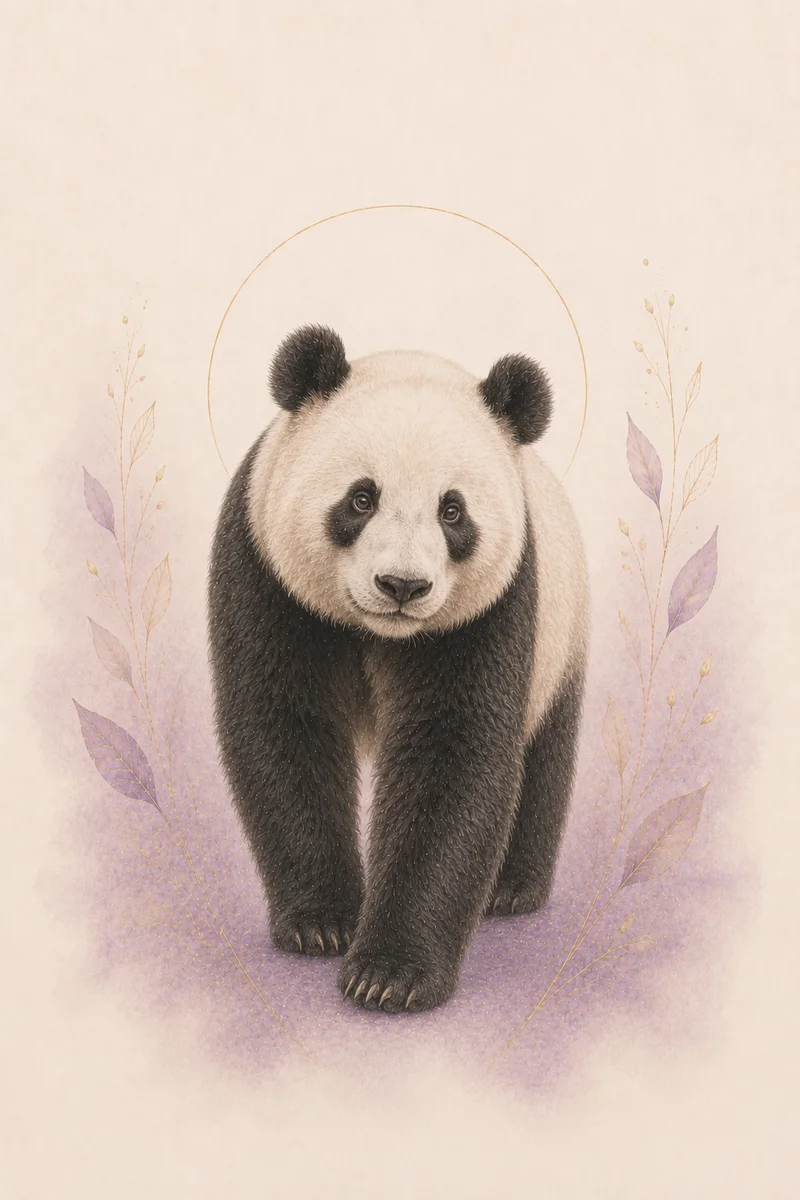
~6 min read
A giant panda spends up to twelve hours a day eating — mostly bamboo, mouthful after mouthful, moving at almost exactly the same unhurried pace from morning to night.
That single fact carries more of panda’s real meaning than its reputation for cuteness ever does: a gentleness that isn’t relaxed at all underneath. It’s being maintained, hour after hour, by constant effort.
Unhurried presence
Underestimated effort
Solitary calm
Mistaken for having endless capacity
Panda Spirit Animal — What the Panda Means
There’s a hard-won quality to panda energy that’s easy to miss under its reputation for cuteness: a gentleness that’s genuine, but not effortless — calm, mild, and steady even under real strain, sustained by a constant, mostly invisible effort running underneath the surface.
That shows up as an unhurried rhythm that holds regardless of what’s being asked of it, and a habit of being read as more available or more relaxed than it actually has the capacity to be. None of this makes panda energy weak or passive — underneath the calm is real strength, used only when needed, not paraded or proven on demand.
Real Panda Behavior Behind the Symbol
Giant pandas belong to the order Carnivora and share the short, simple digestive system built for that lineage — poorly suited to breaking down plant fiber — yet they eat almost exclusively bamboo, a low-nutrient food their gut can’t extract much energy from at all. To compensate, a giant panda spends up to twelve hours a day feeding, and moves in an unhurried, energy-conserving way for nearly all of the rest of it; there simply isn’t spare energy for anything faster. An enlarged wrist bone functions as a kind of opposable pseudo-thumb, letting a panda grip and strip bamboo stalks with precision — a body that still carries a carnivore’s tools, repurposed almost entirely for a plant-based life.
That calm, deliberate demeanor is a real metabolic adaptation to a difficult diet, not a personality trait or a temperament choice. Giant pandas are also, for the most part, solitary, with adults keeping separate home ranges and coming together mainly to mate. And despite the gentle reputation, they retain real physical strength and will defend themselves seriously if threatened — calm is the default here, not an absence of capability. That combination is easy to underestimate from the outside: an animal built with a predator’s strength, running almost entirely on the tight energy budget of a plant-eater.
Sources on the real behavior behind this symbol: science.org, ifaw.org. Full methodology and all 64 animals: see our methodology and sources.
Light and Shadow
At its healthiest, panda energy keeps its gentle, steady pace while being honest that maintaining it takes real, ongoing effort — calm that’s allowed to have a visible cost sometimes, rather than looking effortless at all times. The shadow side is quieter and easier to miss: continuing to perform calm and availability long after actual capacity is gone, because gentleness has become what other people expect rather than what it can currently give.
Worth naming clearly: calm here doesn’t mean spare energy to give — the gentleness is often the harder-won thing, not the easier one — and it isn’t passivity or an inability to defend itself either; giant pandas are physically capable and will assert themselves when it actually matters. Its solitary nature also isn’t loneliness in disguise; solitude is simply its normal, functional state — the quiet isn’t a symptom of anything missing, it’s part of how the whole system is built to run.
Panda Energy in Love, Career, and Growth
In love, this offers steady, undemanding affection, but needs a partner who actually notices the effort sitting underneath the calm, rather than assuming there’s always more where that came from and quietly asking for it anyway.
In career, it does careful, steady work well, but is vulnerable to being handed more than its calm exterior suggests it can carry, and its quiet competence can go unrecognized next to louder colleagues who make their effort visible.
In personal growth, it often points toward letting the real cost of staying calm be visible sometimes, instead of absorbing every new expectation silently just to protect the appearance of ease.
The Inner Conflict — and Today’s Impulse
Panda energy sits with an unresolved tension between gentleness and the pressure to meet expectations: its calm is genuine, but the constant, quiet effort required just to maintain it can be mistaken — even by panda itself — for having nothing left to give when more is asked of it. A constructive response isn’t abandoning gentleness for a harder edge — it’s letting the effort behind the calm be visible sometimes, rather than absorbing every new expectation silently to protect the appearance of ease.
The deeper need here isn’t a push to toughen up — it’s recognition that the gentleness takes ongoing effort to maintain, and permission to say no without breaking the calm it’s known for. An environment that checks in on actual capacity, instead of reading calm as unlimited, makes far more difference here than any amount of internal willpower.
💭 Where is your gentleness being treated as bottomless, when it actually takes real effort to keep?
Calm that takes real work is still calm — and still real.
Frequently Asked Questions
Is the panda my spirit animal?
Perhaps, especially if your gentleness rests on a lot of quiet, unseen effort. We use spirit animal and power animal for one idea: an animal whose qualities reflect a theme you are living with now, not a fixed identity. Pandas eat for up to twelve hours a day and move slowly to conserve energy, which some people find a fitting image for steady strength. The Spirit Animal Quiz can show how close it feels today.
Does the panda power animal mean I’m passive or unable to stand up for myself?
Not at all. Giant pandas are physically capable and will defend themselves seriously if threatened — the gentle reputation doesn’t mean an absence of real strength. This symbolism is about calm that costs real effort, not an inability to hold a boundary when it matters — being easygoing and being defenseless are two entirely different things.
What’s the difference between the panda and the African buffalo as power animals?
African buffalo’s underestimated toughness is proven collectively, out in the open, within and for the herd. Panda’s gentleness is a costly, individual, diet-driven adaptation maintained mostly alone — real strength held privately rather than tested within a group.
Can the panda appear when staying calm for others has started to cost too much?
Yes — often as a prompt to notice how much invisible effort is going into looking fine. If keeping up a calm exterior is consistently costing more than you can actually afford, it’s worth naming that to a trusted person or a professional, rather than continuing to absorb it silently until there’s nothing left underneath it.
The idea of a power animal comes from shamanic and animistic traditions found in many cultures, and is widely used today in Neoshamanism.
If this isn’t quite about you — maybe it’s about someone else. Talk to Marie about what you’re noticing in them, and see what animal actually fits.
Related Power Animals
African Buffalo — shares the theme of underestimated strength beneath a mild exterior, but leans more into toughness proven collectively within a herd, while panda’s gentleness is a costly, individual adaptation maintained mostly alone.
Swan — also about effortless-looking calm that hides real work, but leans more into sustaining visible grace within an active partnership, while panda’s hidden effort goes into simply maintaining its own steady baseline.
