
Moth Spirit Animal Meaning: Attraction, Instinct and Risk
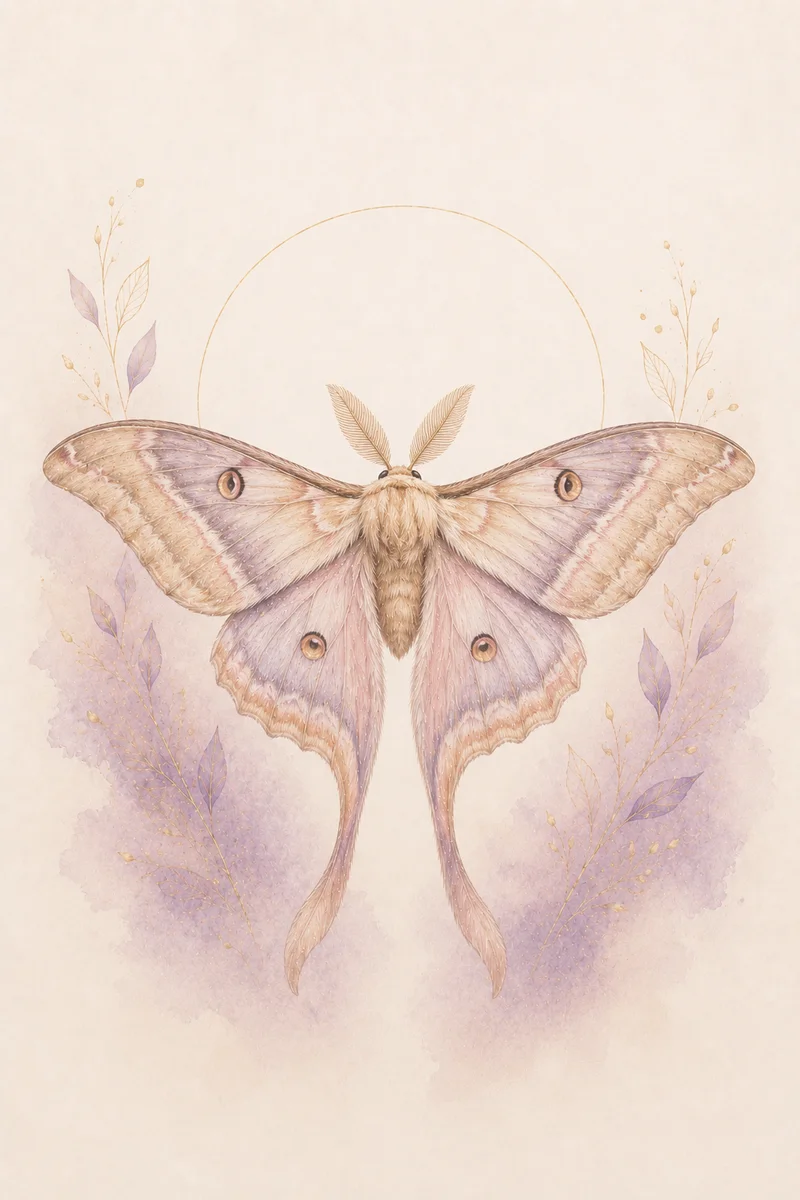
~5 min read
Maybe there’s a person, a choice, or a plan you can’t stop circling back to, even though you couldn’t say for certain whether it’s good for you or just genuinely reckless. You lean toward it anyway, again and again, pulled by something you can’t fully explain and haven’t quite decided to trust.
That’s close to a moth’s whole way of moving through the world — attention bent toward something bright and not yet understood, sometimes reading it exactly right, sometimes not.
Instinctive sensitivity
Risk
Nocturnal instinct
Misreading its own signals
Moth Spirit Animal — What the Moth Means
Moth energy is a pull toward the unknown, felt before there’s any real proof of what’s on the other side of it. It isn’t idle curiosity — it’s a genuine tug toward something uncertain, half-hidden, or not yet understood, moving mostly through instinct and sensitivity rather than a fully deliberate plan.
That shows up as a real willingness to move toward what others might avoid as too risky or too dark, and an ability to notice subtle signals — mood, tension, possibility — that most people miss entirely. The same sensitivity that catches what others don’t can, sometimes, misread exactly what it’s walking toward.
Real Moth Behavior Behind the Symbol
Moths are an enormous, genuinely diverse group — tens of thousands of species, many of them vividly colored and active by day, not the uniformly drab, purely nocturnal image the word usually calls to mind. Among the many species that are active at night, flight is guided in part by orienting to natural light sources; researchers believe nearby artificial lights disrupt that orientation, which is the most likely explanation for the familiar spiraling flight toward a lamp or flame — not a deliberate pull toward danger.
Moths are largely solitary, finding food, shelter, and mates independently, often locating each other across long distances by scent alone. For daytime safety, many species rely on camouflage that matches bark or leaves almost exactly, and some can hear a bat’s echolocation calls and peel off into sudden evasive turns mid-flight — a handful even produce their own ultrasonic clicks to jam a bat’s sonar outright.
Sources on the real behavior behind this symbol: nature.com, fws.gov. Full methodology and all 64 animals: see our methodology and sources.
Light and Shadow
In its healthy form, moth energy follows a genuine attraction while staying aware enough to notice when a pull is leading somewhere disorienting rather than somewhere real. The shadow side is repetition without reassessment: circling the same risky draw long after it’s clearly not leading anywhere safe, mistaking the intensity of the pull itself for a reason to keep following it.
Worth naming clearly: this isn’t an innate self-destructive drive — a moth spiraling toward a light is most likely a navigational error, not a death wish — and a pull that led somewhere disorienting doesn’t mean poor judgment. Sensitivity to subtle cues most people miss is a real strength, even on the occasions it misfires.
Moth Energy in Love, Career, and Growth
In love, this often feels like a pull toward what’s intense, mysterious, or not fully known about a person — worth watching for mistaking that intensity itself for real connection.
In career, it tends to favor ambiguous or higher-risk paths over clearly lit, well-trodden ones, though it’s worth checking how far an attraction is actually still serving you.
In personal growth, it often points toward learning which pulls are genuinely nourishing and which are only disorienting, ideally with a trusted outside perspective when that’s hard to read from the inside.
The Inner Conflict — and Today’s Impulse
Moth energy sits with an unresolved tension between attraction and danger: its sensitivity draws it powerfully toward things it doesn’t yet fully understand, and that same sensitivity can’t always tell in advance whether what’s pulling it is a real opening or a dead end. A constructive response isn’t ignoring the pull — it’s treating it as real information worth noticing, then checking it against what it actually finds once it gets close.
The deeper need here isn’t less attraction — it’s space to follow a genuine pull without being immediately judged for it, and a way to check whether it’s safe before committing fully.
💭 Is this pull leading you somewhere real, or is it just the brightest thing nearby?
Not every pull toward the light is a mistake — but some are.
Frequently Asked Questions
Is the moth my spirit animal?
A moth may come to mind when you feel an instinctive pull toward something uncertain, or notice subtle signals others miss. In this guide spirit animal and power animal share one meaning: an animal whose qualities mirror a theme in your life right now, not a fixed identity. It can also invite a gentle question about whether a particular pull is leading anywhere useful. The Spirit Animal Quiz can show how close it feels today.
Does the moth power animal mean I have a self-destructive streak?
Not really. A moth spiraling toward a light is most likely a navigational error — artificial light disrupts a system built for reading the moon — not a death wish. The pull itself is the point here, not any underlying drive toward harm.
What’s the difference between the moth and the jellyfish as power animals?
Jellyfish is carried more generally by current, without any single fixed point of pull. Moth’s pull is more specific and chosen-feeling — an active draw toward one particular uncertain thing, not motion without any direction at all.
Can the moth appear when a pull keeps leading somewhere that isn’t good for me?
Yes — often as a prompt to check the pull against what it actually finds, rather than trusting intensity alone. If you keep noticing the same pull leading into situations that hurt you, it’s worth naming that pattern to a trusted person or a professional, not just working through it alone.
The idea of a power animal comes from shamanic and animistic traditions found in many cultures, and is widely used today in Neoshamanism.
Not sure if the moth is really your animal, or if your situation actually calls for something else? Marie can help you tell the difference.
Related Power Animals
Jellyfish — shares the theme of being carried by something larger than deliberate control, but leans more into drifting generally with the current, while moth is more about an active pull toward one specific, chosen-feeling attraction.
Raven — also about noticing what others miss, but leans more into pattern-recognition aimed at clarity, while moth’s sensitivity can occasionally misread its own signals and lead somewhere disorienting.
