
Lion Spirit Animal Meaning: Visible Leadership, Protective Exposure and Earned Position
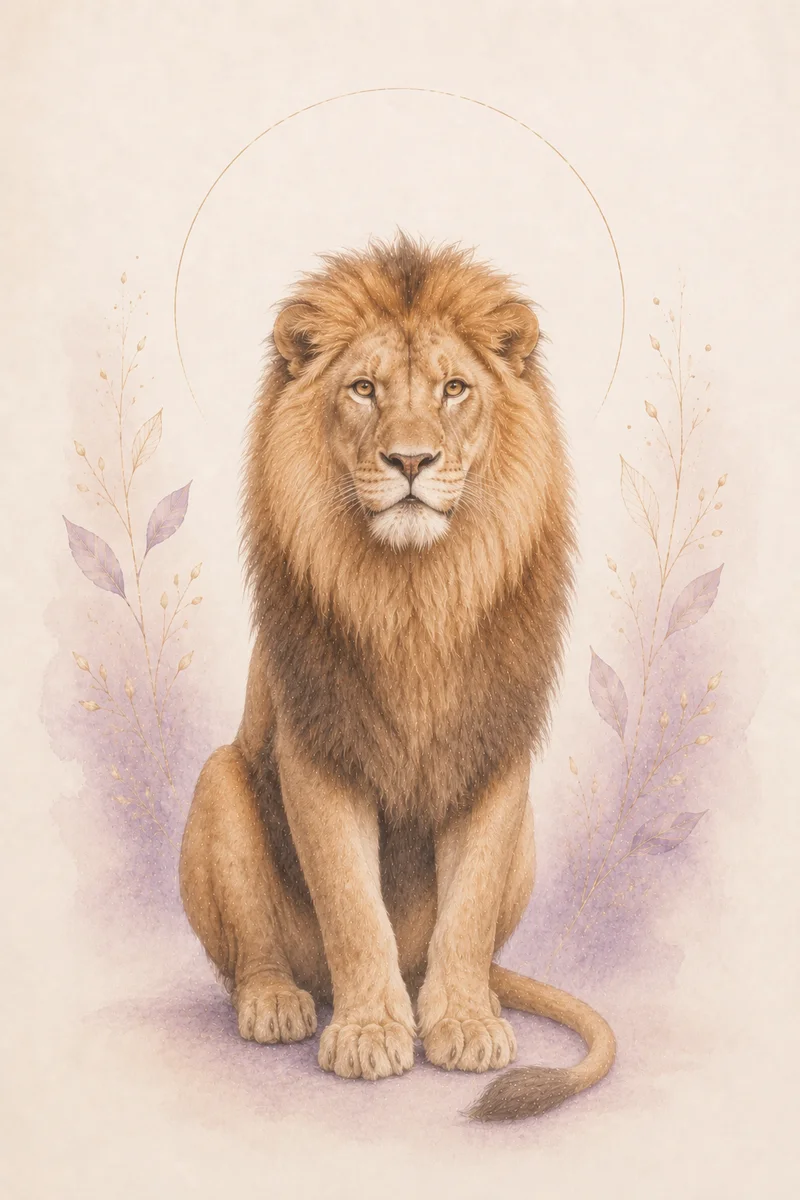
~5 min read
Call a lion “king of the jungle” and two things are already wrong: lions don’t live in jungles, and no single male actually runs a pride day to day. The related females who stay in the pride for life do most of the cooperative hunting and cub-rearing — a coalition of resident males mostly holds and defends the territory around them.
What actually holds up under closer attention isn’t a throne. It’s a much harder, more exposed position — standing visibly at the center of a group’s safety, in full view, with real limits that everyone around you can see too.
Protective exposure
Earned position
Responsibility
Being constantly watched
Position under challenge
Lion Spirit Animal — What the Lion Means
Lion energy is a visible center of gravity for a group — strength that has to be shown, openly, even when showing it costs something real. Its symbolism isn’t about ruling anything or holding power over anyone; it’s about standing where everyone can see you and carrying responsibility that people are genuinely counting on.
That shows up as decisions made in full view rather than behind closed doors, a role others depend on and can point to directly, and an awareness that any sign of weakness will be seen just as clearly as any sign of strength. Underneath runs a real cost that’s easy to overlook from the outside: being constantly watched and depended on takes something out of a lion that rarely gets acknowledged, let alone accounted for.
Real Lion Behavior Behind the Symbol
Lions live in prides built around a stable core of related females, who remain in the pride for life and do most of the cooperative hunting and cub-rearing together. A coalition of resident males defends the pride’s territory instead, typically holding that position for only a few years before being challenged and displaced by rival males.
Survival here leans heavily on visible signaling — roaring, mane display, and territory marking by males — meant to deter rivals before physical conflict actually becomes necessary. It’s a matrilineal system at its core: female lineages carry the pride’s real continuity across generations, while male tenure stays temporary and has to be actively defended, again and again, just to be kept at all.
Sources on the real behavior behind this symbol: education.nationalgeographic.org. Full methodology and all 64 animals: see our methodology and sources.
Light and Shadow
At its best, lion energy leads openly and lets the group see its real limits too, without waiting for a crisis to force that admission. The shadow side is performing unshakeable strength for so long that exhaustion or fear ends up with nowhere left to go — a front that holds right up until it can’t.
Worth naming clearly: none of this is about conquest or aggression for its own sake, and visible authority here was never a guarantee that the position is secure or permanent — a pride’s day-to-day running has always depended on cooperative, related females far more than on any single dominant figure.
Lion Energy in Love, Career, and Growth
In love, this tends to show care through visible responsibility for a partner’s safety and stability — worth watching for real difficulty being genuinely vulnerable inside the very relationship it’s protecting.
In career, it suits visible leadership roles that require standing publicly behind decisions, though the pressure of being constantly watched can crowd out honest uncertainty when it matters most.
In personal growth, it often means learning, slowly, that rest isn’t weakness — and if exhaustion is being hidden behind a strong front for too long, that’s worth naming to a professional rather than pushed through completely alone.
The Inner Conflict — and Today’s Impulse
Lion energy lives with a real back-and-forth between authority and vulnerability: the position depends on projecting visible, dependable strength, yet that same visibility leaves little room for exhaustion, fear, or uncertainty to go unnoticed. The useful shift isn’t hiding those moments more carefully — it’s letting real strength include visible moments of limitation, rather than waiting for a crisis or a challenger to force the admission out of it.
What this usually calls for isn’t more confidence to project — it’s a way to be visibly strong without hiding every sign of strain, and real trust that the group can hold steady even after actually seeing its leader falter briefly.
💭 Where are you carrying visible responsibility without anyone seeing what it actually costs you?
The strength that can never look tired is not the strength that lasts.
Frequently Asked Questions
Is the lion my spirit animal?
A lion may feel close when you hold a visible role that others depend on and carry costs people rarely notice. Spirit animal and power animal are used interchangeably on this site: an animal whose qualities reflect a theme in your life right now, never a fixed identity. Prides are built on cooperation, so the symbol is about shared responsibility, not a solitary crown. The Spirit Animal Quiz can show how close it feels today.
Does the lion power animal mean I’m meant to dominate or control everyone around me?
Not really. Lion symbolism isn’t about dominance or conquest — prides are led day to day by cooperative, related females, not a single ruling male. What it actually points to is visible responsibility carried openly, not control for its own sake.
What’s the difference between the lion and the wolf as power animals?
Wolf’s strength comes from belonging earned within a reciprocal peer bond, shared inside the group. Lion’s leadership is individually visible — a standalone position that carries direct exposure to the group’s judgment and need, and can’t easily be shared or rotated away.
Can the lion appear during a period of carrying more responsibility than feels sustainable?
Yes — often as a prompt to let real limits show before exhaustion forces the issue. If that pressure has turned into chronic depletion hidden behind a strong front, it’s worth naming concretely to a trusted person or a professional, rather than just pushing through it alone.
The idea of a power animal comes from shamanic and animistic traditions found in many cultures, and is widely used today in Neoshamanism.
If this isn’t quite about you — maybe it’s about someone else. Talk to Marie about what you’re noticing in them, and see what animal actually fits.
Related Power Animals
Wolf — shares the theme of leadership connected to a group, but leans more into belonging earned inside a reciprocal peer bond, while lion’s leadership is a single, visible position carrying direct exposure to the group’s judgment.
Meerkat — shares the theme of a role the group depends on, but leans more into watchfulness explicitly rotated through the whole group, while lion holds one sustained, visible position that isn’t easily shared.
