
Leopard Spirit Animal Meaning: Coiled Readiness, Patient Concealment and Controlled Power
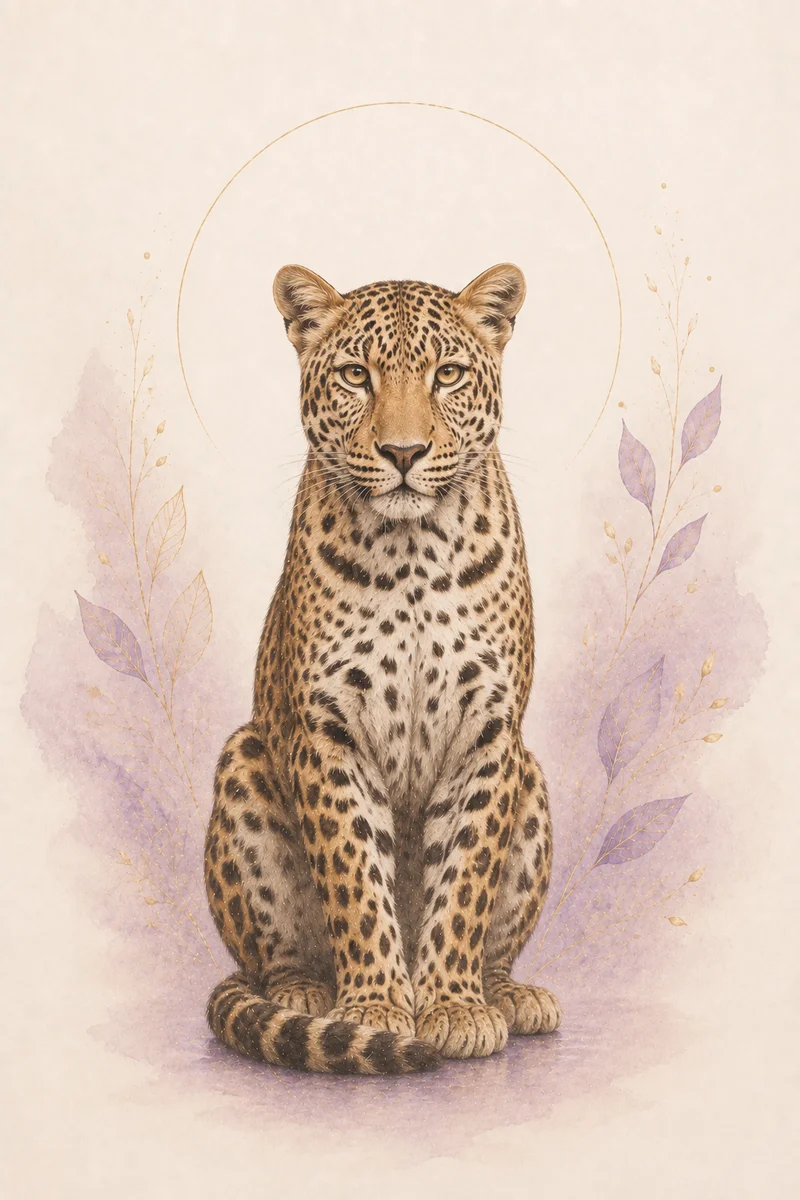
~5 min read
A leopard can hold a single position, half-hidden in dappled leaf-shadow, for far longer than most predators would ever bother — then close the last few meters of that same distance in under a second, before the movement has even fully registered as movement.
That contrast is the leopard’s whole strategy folded into one moment: the stillness isn’t the absence of effort. It’s where almost all the actual work happens, quietly, well before anything visible occurs at all.
Coiled readiness
Active stillness
Controlled power
Readiness curdling into frustration
Being underestimated
Leopard Spirit Animal — What the Leopard Means
At the center of leopard symbolism is a readiness that stays fully active even while nothing visible is happening — patient concealment that isn’t passivity, but a coiled, ongoing kind of strength. A leopard’s power comes from staying hidden for exactly as long as a moment actually requires, then committing completely once it finally moves, without ever needing to announce that readiness in the meantime.
That shows up as a real capacity to hold a concealed position without giving anything away, full decisiveness the instant a genuine opening appears, and a tendency to be underestimated by people who mistake quiet for passivity. Underneath runs a real tension between staying hidden and the pull to finally commit to the move.
Real Leopard Behavior Behind the Symbol
Leopards are solitary big cats that rely on camouflage and close-range stealth, stalking prey at close quarters before a short, explosive charge rather than a long, sustained chase. Their rosette-patterned coat keeps them effectively hidden at close range, letting them close the distance on prey that would spot them instantly out in the open.
They’re territorial outside of mating and raising young, and among the most elusive big cats alive — rarely observed even in places where they’re locally common. Strength backs up the stealth: a leopard is capable of carrying a kill up into a tree, sometimes heavier than its own body weight, to keep it safe from scavengers — a rare combination of concealment and raw physical power in one animal.
Sources on the real behavior behind this symbol: lionstigersandbears.org, ifaw.org. Full methodology and all 64 animals: see our methodology and sources.
Light and Shadow
When it’s working well, leopard energy stays fully concealed and ready for exactly as long as a moment requires, then commits with total, decisive strength once it actually moves. The shadow side cuts both ways: breaking concealment too early out of restlessness, or staying hidden so long that readiness curdles into frustration instead of ever actually getting used.
Worth naming clearly: none of this is passivity — leopard’s stillness is active, coiled strength, not the absence of effort — and the explosive nature of the strike itself doesn’t make aggression a personality trait. Its solitary, elusive nature isn’t a lack of real capability either; leopard is one of the most adaptable and widespread big cats precisely because of this strategy.
Leopard Energy in Love, Career, and Growth
In love, this tends to hold back and observe before committing, then move with real, focused intensity once it actually does — worth watching for staying so concealed emotionally that a partner never quite sees the readiness underneath.
In career, it excels in situations that reward patient preparation followed by decisive, well-timed execution, though it can be underestimated by people who only notice the quiet buildup and miss the real strength working underneath it the whole time.
In personal growth, it often means real recovery after a period of sustained, coiled tension — and if concealment has become a permanent state rather than a phase before action, that’s worth naming to a professional.
The Inner Conflict — and Today’s Impulse
Leopard energy sits with an unresolved tension between patience and impatience: its strength depends on holding concealment for exactly as long as it takes, but that same coiled readiness can tip into breaking cover too soon, or curdle into frustration if it holds on too long. The point isn’t forcing the moment early, or letting the readiness go stale from waiting — it’s trusting the waiting itself as real, active work, so it doesn’t have to feel like doing nothing.
The deeper need here isn’t a faster trigger — it’s trust that this patience is genuine strength, not inaction, and a real, well-timed moment where all that readiness can actually be used.
💭 Where are you holding real strength in reserve — and how will you know when it’s time to use it?
Concealment is not the opposite of strength — sometimes it’s the shape strength takes while it waits.
Frequently Asked Questions
Is the leopard my spirit animal?
Many people connect with the leopard when they are waiting patiently, staying hidden for as long as a moment requires, and then committing fully. Spirit animal and power animal mean the same here: an animal whose qualities mirror a theme in your life right now, not a fixed identity. It can also point to the strain of holding readiness too long. The Spirit Animal Quiz can show how close it feels today.
Does the leopard power animal mean I’m passive or hesitant?
Not at all. Leopard’s stillness is active, coiled strength, not the absence of effort — it’s patience that’s already doing real work, not hesitation or a lack of readiness.
What’s the difference between the leopard and the heron as power animals?
Heron’s patience is a visible, motionless waiting that reads as passive from the outside. Leopard’s patience stays concealed and coiled — active readiness that stays hidden until the exact moment it’s actually needed.
Can the leopard appear during a period of prolonged tension or waiting?
Yes — often as a prompt to trust that the waiting itself is real work, not stalling. But if that coiled tension has gone on so long it’s turned into real strain or exhaustion, it’s worth naming concretely to a trusted person or a professional, rather than just holding it alone.
The idea of a power animal comes from shamanic and animistic traditions found in many cultures, and is widely used today in Neoshamanism.
Symbols tend to mean more in conversation than they do on a page. If the leopard is asking something of you, Marie is a good place to find out what.
Related Power Animals
Heron — shares the theme of patience before the right moment, but leans more into a visible, motionless waiting, while leopard’s patience stays concealed, active strength on its way toward a strike.
Falcon — shares the theme of patience before the right moment, but leans more into a rapid, open-air build toward one high-speed strike, while leopard’s readiness holds patiently at close range, under cover, for as long as it takes.
