
Jellyfish Spirit Animal Meaning: Trust in Flow, Surrender and Soft Resilience
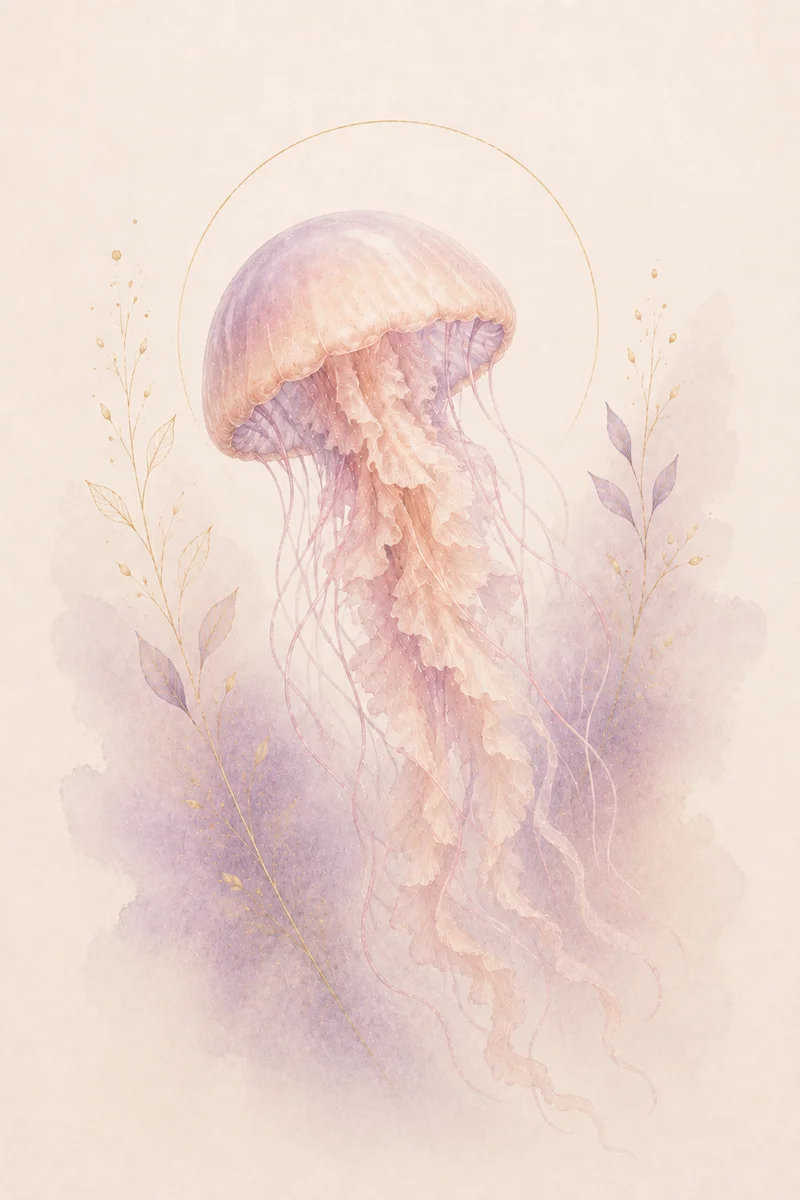
~6 min read
It’s easy to picture a jellyfish as pure cargo — a limp, mindless blob pushed wherever the ocean happens to take it, stinging on contact with no say in the matter at all. That picture holds up right up until you actually watch one: a steady pulse moving through its bell, again and again, actively orienting itself even as the current carries it along.
Drifting and directing turn out not to be opposites here. A jellyfish can let something much larger than itself set the general course, while still doing real, continuous work to hold its own shape and sense of up.
Surrender with structure
Soft resilience
Responsive drifting
Mistaking passivity for trust
Jellyfish Spirit Animal — What the Jellyfish Means
At its core, jellyfish symbolism is movement that trusts a current without giving up its own shape — letting circumstances carry it forward while still maintaining its own rhythm and sense of orientation. It doesn’t force a fixed direction against something far bigger than itself, but it isn’t inert either: real, continuous small effort keeps it intact and oriented the whole time it’s being carried.
That shows up as genuine adaptability to changing conditions, a willingness to let go of control over the exact route, and a quiet trust that drifting isn’t the same thing as being lost. Underneath sits a real tension between letting go and fearing the complete loss of control — the difference between surrender that stays structured and surrender that simply dissolves.
Real Jellyfish Behavior Behind the Symbol
Jellyfish move primarily by pulsing their bell-shaped bodies to propel themselves, while largely drifting with ocean currents rather than swimming directly against them — propulsion and surrender working together rather than one canceling the other out. Many jellyfish species are largely solitary, though some can form large seasonal aggregations, called blooms, shaped by currents and conditions rather than any real social bonding.
Many jellyfish species lack a brain or centralized nervous system, relying instead on a distributed nerve net spread through the body — a structure that still lets them sense light, respond to touch, and actively orient themselves as they move. “Jellyfish” is also a broad, informal name covering a wide range of different animals — true jellyfish, box jellyfish, and comb jellies are often grouped together in everyday language but belong to distinct branches of the animal kingdom — so the finer details of how any one of these systems works can vary meaningfully from species to species.
Many jellyfish species also pass through more than one body form over a lifetime, starting as a tiny, stationary polyp attached to the seafloor before eventually budding off into the free-swimming, drifting form most people picture. That means the drifting, carried life so central to jellyfish symbolism is often only one chapter of a longer story that began fixed firmly in place.
Sources on the real behavior behind this symbol: britannica.com, science.ku.dk. Full methodology and all 64 animals: see our methodology and sources.
Light and Shadow
At its healthiest, jellyfish energy lets a current carry it forward while still moving with its own rhythm and staying fully intact as itself. The shadow side is quieter: going fully passive, losing all real sense of direction or self, and mistaking that total surrender for trust rather than recognizing it as something that’s actually stopped serving anyone.
Worth naming clearly: none of this is mindlessness or a total lack of agency — jellyfish actively pulse and orient even while drifting with a current. Surrender here doesn’t mean helplessness either; letting go can be a fully deliberate, active choice. And a soft structure isn’t automatically a weak one — softness and real resilience aren’t opposites, even if a body without a rigid skeleton often reads as more fragile than it actually is.
Jellyfish Energy in Love, Career, and Growth
In love, this tends to stay open and adaptable within a relationship without losing its own rhythm — worth watching for over-adapting to a partner’s current until its own needs quietly disappear.
In career, it adapts well to shifting conditions and unclear structure, moving fluidly through change that would exhaust a more rigid approach, though it may struggle in environments that reward fixed control instead.
In personal growth, it often points toward allowing things to move at their own pace rather than forcing an outcome before it’s actually ready, while still checking in regularly on its own sense of direction.
The Inner Conflict — and Today’s Impulse
Jellyfish finds real ease by letting a current carry it, but full surrender risks losing the very shape and orientation it needs to stay itself in the process. The useful shift isn’t resisting the current out of fear, and it isn’t dissolving into it either — it’s letting go of the direction while keeping its own quiet rhythm, trusting the current without abandoning its own form entirely.
Underneath, what’s often needed isn’t more control over every outcome — it’s permission to let a situation carry it forward, paired with real reassurance that surrendering direction doesn’t mean losing itself in the process. A stable enough sense of its own rhythm is often what makes that permission feel safe to give in the first place.
💭 Where could you let go of steering, without losing your own shape in the process?
Being carried is not the same as being lost.
Frequently Asked Questions
Is the jellyfish my spirit animal?
Many people feel drawn to the jellyfish when life asks them to trust the current without losing their own shape. Spirit animal and power animal describe the same idea on this site: a creature whose qualities reflect something you are living through now, not who you are forever. A jellyfish pulses gently while it drifts, so it can mirror soft resilience. The Spirit Animal Quiz can show how close it feels today.
Does the jellyfish power animal mean I have no real control or direction?
Not primarily. Jellyfish actively pulse and orient even while drifting with a current — this symbolism is about deliberate, chosen surrender, not helplessness or a total lack of agency.
What’s the difference between the jellyfish and the octopus as power animals?
Octopus adapts through deliberate, hands-on problem-solving intelligence, actively reshaping its approach to a new obstacle. Jellyfish adapts by letting a current carry it while still actively orienting itself — both are about adaptation, just through very different means.
Can the jellyfish appear when someone feels like they’ve lost all control over a situation?
Yes — often as a prompt to find the difference between trusting a process and losing track of yourself inside it. That difference isn’t always obvious from the inside, especially when the feeling of drifting has gone on for a while. If a persistent sense of having no control at all over your own direction has settled in, it’s worth naming that concretely to a trusted person or a professional, rather than treating it only as something to drift through.
The idea of a power animal comes from shamanic and animistic traditions found in many cultures, and is widely used today in Neoshamanism.
A page can only tell you what the jellyfish means in general. Marie can help you find out what it means for you, right now.
Related Power Animals
Octopus — shares the theme of adaptation to circumstance, but leans more into active, deliberate problem-solving intelligence, while jellyfish adapts by letting a current carry it while still actively orienting itself.
Swan — also carries an effortless-looking surface over real activity underneath, but leans more into hiding continuous, deliberate effort beneath that calm, while jellyfish’s calm comes from surrendering direction to the current.
