
Frog Spirit Animal Meaning: Metamorphosis, Transition and Belonging
~5 min read
There’s a particular hush at the edge of a pond at dusk — a small, damp rustle of movement in wet grass, a pause, then a chorus of overlapping calls rising all at once from the reeds, as if on some signal only they could hear.
That sound belongs to an animal built for exactly this kind of in-between: not fully of the water, not fully of the land, but genuinely, functionally able to belong in both — moving between them again, not stuck permanently in either.
Dual habitats
In-between belonging
Threshold dwelling
Feeling unmoored
Frog Spirit Animal — What the Frog Means
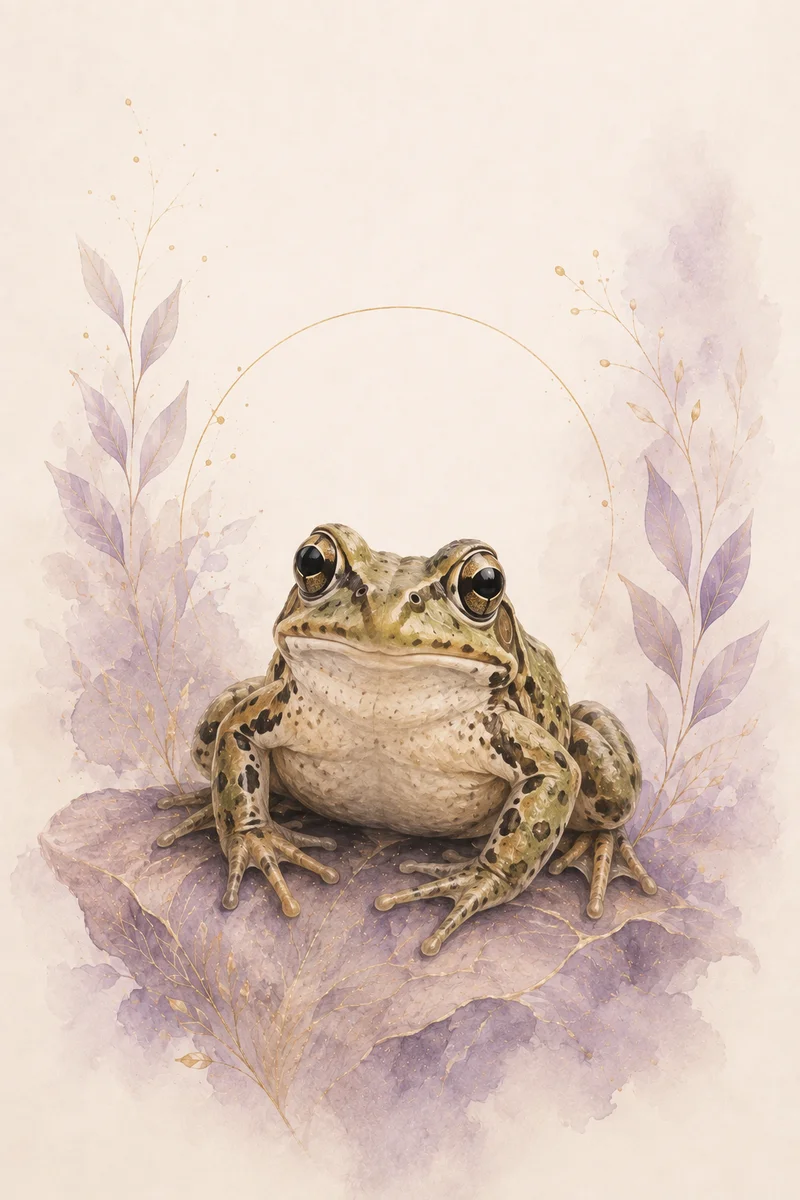
Frog symbolism centers on a life lived fully in two different worlds — water and land, one stage and the next — changing shape completely to belong in each. It isn’t one dramatic transformation finished once and set aside; for many frog species, moving between habitats continues through much of adult life, not just as a one-time juvenile milestone.
That shows up as real comfort with in-between periods, an instinct to keep moving toward the next stage rather than stall in place, and a felt sense of not being fully one thing or the other yet — which, in this symbolism, is never treated as the same thing as not belonging at all.
Real Frog Behavior Behind the Symbol
Frogs undergo complete metamorphosis: an aquatic, gilled tadpole gradually develops legs and lungs and emerges as an air-breathing adult. As amphibians, many frog species continue moving between water and land through much of their adult life rather than settling permanently in one habitat — the transition itself is less a single event than an ongoing way of living.
Social habits vary widely across the thousands of frog species; many are largely solitary outside of breeding choruses, when males call together, often in overlapping waves, to attract mates. Their skin is permeable and moisture-dependent, absorbing oxygen and water directly from the surrounding environment — a specific physical adaptation tying each frog closely to whatever habitat it’s actually in at that stage, not a broader metaphor for fragility.
Sources on the real behavior behind this symbol: britannica.com. Full methodology and all 64 animals: see our methodology and sources.
Light and Shadow
Lived well, frog energy moves through each transition fully, trusting that belonging can be rebuilt in the new form or place rather than only existing in the last one. The shadow side shows up as getting stuck mid-change — neither committing to what’s being left behind nor actually arriving in what’s next.
Worth naming clearly: this isn’t one dramatic, single transformation like a butterfly’s — many frogs keep moving between water and land their whole adult life, not just once. It also isn’t instability or a lack of direction; moving between habitats and life stages is the frog’s normal, functional way of living. And permeable, moisture-dependent skin is a specific physical trait, not a metaphor for being emotionally thin-skinned.
Frog Energy in Love, Career, and Growth
In love, relationships that shift and change shape over time tend to feel natural rather than threatening — though staying settled in a bond that’s asked to remain exactly the same indefinitely can be harder.
In career, it adapts well across role changes, pivots, or moves between very different environments, even when the specific in-between stretch before a new identity feels solid leaves it a little unmoored.
In personal growth, it often points toward giving an actual transition the time it needs to finish, rather than expecting to feel at home before it has.
The Inner Conflict — and Today’s Impulse
Frog energy sits with an unresolved tension between transition and belonging: moving fully into a new stage is exactly what leaves it, for a while, without a settled sense of belonging to either the world it left or the one it’s entering. The useful shift isn’t rushing to feel at home again — it’s letting belonging get rebuilt fresh in the new stage, rather than measured against the one that’s already gone.
The deeper need here isn’t a faster arrival — it’s a genuine sense of belonging in whatever stage it’s actually in, and enough time to let the transition actually finish before anyone expects it to feel settled.
💭 Which parts of your old life are you still trying to breathe through, even now that you live somewhere new?
Belonging can be rebuilt in a new shape — it doesn’t only exist in the last one.
Frequently Asked Questions
Is the frog my spirit animal?
For many people, the frog arrives during a period of transition. This site uses spirit animal and power animal interchangeably, meaning an animal whose qualities can mirror a theme in your life now, rather than a fixed identity. Frogs begin as water-bound tadpoles and become air-breathing adults, so the frog can be a mirror for change and belonging between two worlds. The Spirit Animal Quiz can show how close it feels today.
Does the frog power animal mean I’m going through one big, one-time transformation?
Not necessarily. That’s closer to a butterfly’s single metamorphosis. Many frog species keep moving between water and land through much of their adult life — frog symbolism is about an ongoing pattern of transition, not one dramatic, one-time change.
What’s the difference between the frog and the butterfly as power animals?
Butterfly’s transformation is a single, complete, one-way change into a final form. Frog moves repeatedly between different habitats and forms across its life — an ongoing pattern rather than one visible turning point.
Can the frog appear when a transition feels like it’s stalled out?
Yes — often as a prompt to notice where you’re still holding onto the old stage instead of finishing the move into the new one. If a transition has felt stuck for a long stretch, with no real sense of forward movement, it’s worth naming that to a trusted person or a professional, rather than just waiting it out.
The idea of a power animal comes from shamanic and animistic traditions found in many cultures, and is widely used today in Neoshamanism.
If this isn’t quite about you — maybe it’s about someone else. Talk to Marie about what you’re noticing in them, and see what animal actually fits.
Related Power Animals
Butterfly — shares the theme of transformation, but its change is a single, complete metamorphosis into a final form, while frog moves repeatedly between different habitats and forms throughout its life.
Snake — shares the theme of renewal, but sheds its skin to renew the same continuous self without changing what or where it fundamentally is, while frog’s transition changes its actual body and habitat as it moves through distinct life stages.
