
Chameleon Spirit Animal Meaning: Social Attunement, Adaptation and Authenticity
~7 min read
“I can tell exactly what this room needs from me right now.” That instinct is closer to an actual chameleon’s coloring than any idea of hiding — most color change happens for mood, temperature, and social signaling, not camouflage.
It’s a finely tuned read of context, expressed directly through the body — and it raises a real question about how much of that shifting is genuine attunement, and how much starts to cost something.
Blending In
Context-Sensitivity
Quiet Self-Monitoring
Mistaken for Two-Facedness
Constant Self-Monitoring
Chameleon Spirit Animal — What the Chameleon Means
Chameleon energy is a presence that reshapes itself to match whatever room it’s just walked into — a heightened, near-constant awareness of the surrounding social atmosphere, and a readiness to shift tone or presentation the moment that atmosphere changes. This adaptation is a genuine skill, not automatically a symptom of anxiety.
That shows up as reading a room’s mood or expectations quickly, moving comfortably across very different social settings, and — underneath — a quiet uncertainty about which version of itself, after all that shifting, is actually the real one.
Real Chameleon Behavior Behind the Symbol
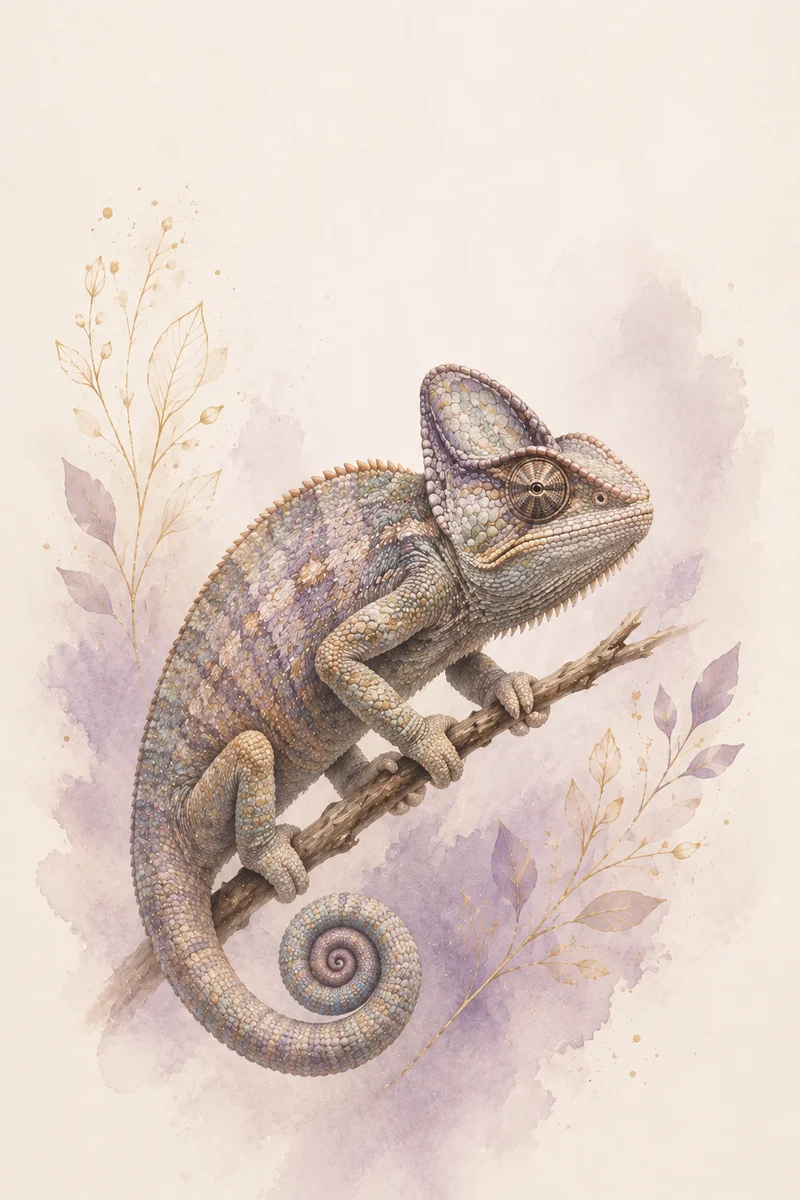
Color change in chameleons is driven mainly by mood, temperature regulation, and social signaling — particularly during aggression or courtship display — through specialized skin cells that shift the spacing of light-reflecting nanocrystals. It’s a communication system more than a disappearing act, despite the popular association with camouflage.
Chameleons are largely solitary and territorial; color and posture communicate status or intent to other chameleons, not concealment from them. Their survival strategy leans on other tools entirely: independently mobile eyes offering near-360-degree vision, slow and deliberate movement that avoids drawing attention, and a long projectile tongue that lets them feed without needing to actively chase anything down.
Sources on the real behavior behind this symbol: nationalgeographic.com, nationalgeographic.com (University of Geneva research). Full methodology and all 64 animals: see our methodology and sources.
Light and Shadow
Lived well, chameleon energy adjusts its presentation to different settings while still knowing, underneath, what it actually wants and believes. The shadow side is quieter and easier to miss: blending in so completely and so often that it loses track of what it would actually choose without an audience watching.
Worth naming clearly: this isn’t two-facedness or deceit — adjusting to a room isn’t the same as lying about who you are — and it isn’t mainly about hiding either; color change is driven more by mood and social signaling than camouflage. Nor is the constant social reading automatically anxiety; it can be a genuine skill.
Chameleon Energy in Love, Career, and Growth
In love, this often shows up as close attunement to a partner’s mood, adjusting accordingly — sometimes before it’s even named its own preference underneath.
In career, it tends to adapt smoothly to different teams and expectations, though it can blend in so completely that its own distinct contribution goes unnoticed.
In personal growth, it often points toward finding at least one context where it doesn’t have to actively monitor and adjust — a place its preferences can surface without checking the room first.
The Inner Conflict — and Today’s Impulse
Chameleon energy holds an ongoing tension between adaptation and authenticity: it adjusts fluidly to whatever social environment it’s in, but shifting itself to match every room it enters can blur its own sense of what it actually wants underneath. A constructive response isn’t refusing to adapt — it’s practicing a genuine preference in small, low-stakes moments, even while it keeps reading the room.
Underneath, what’s often needed isn’t being told to simply “be yourself” — that rarely means much without more context — it’s real clarity about its own preferences, separate from whoever it happens to be around, and at least one setting where it doesn’t need to monitor itself at all.
💭 Who are you when nobody nearby needs you to be anything in particular?
Fitting in and disappearing are not the same thing.
Frequently Asked Questions
Is the chameleon my spirit animal?
Often, a chameleon connection is read as a sign of social attunement, adaptation and the question of staying authentic. Spirit animal and power animal are treated as one idea in these pages: an animal whose qualities reflect something in your life at present, not a fixed label. Real chameleons change color mainly in response to mood and social signals. The Spirit Animal Quiz can show how close it feels today.
Does the chameleon power animal mean I’m being two-faced or dishonest?
Not primarily. Adjusting to a room isn’t the same as lying about who you are — chameleon symbolism is about genuine social attunement, not deceit.
What’s the difference between the chameleon and the octopus as power animals?
Octopus adapts through active, intelligence-driven problem-solving, reshaping itself while holding onto its own throughline. Chameleon’s adaptation leans more passive — a default response to match its immediate social surroundings.
Can chameleon energy show up when someone feels like they don’t know who they are outside of other people?
Yes — often as a sign that social attunement has outpaced a clear sense of one’s own preferences. If that uncertainty feels persistent or distressing, it can help to talk with someone you trust or a professional, rather than trying to sort it out alone.
The idea of a power animal comes from shamanic and animistic traditions found in many cultures, and is widely used today in Neoshamanism.
This page describes what the chameleon means in general. Marie can help you figure out whether it’s really the chameleon your current situation needs — or something else entirely.
Related Power Animals
Octopus — shares the theme of adaptation and blending, but leans more into active, intelligence-driven problem-solving that holds onto its own throughline, while chameleon adapts more as a passive default, shifting its presentation to match whatever social environment it’s currently in.
Coyote — shares the theme of adaptation, but leans more into resilience through actual instability rather than social fit, while chameleon’s adaptation is more about matching its immediate social surroundings, with authenticity as the real risk.
