
Bee Spirit Animal Meaning: Contribution, Identity and Belonging
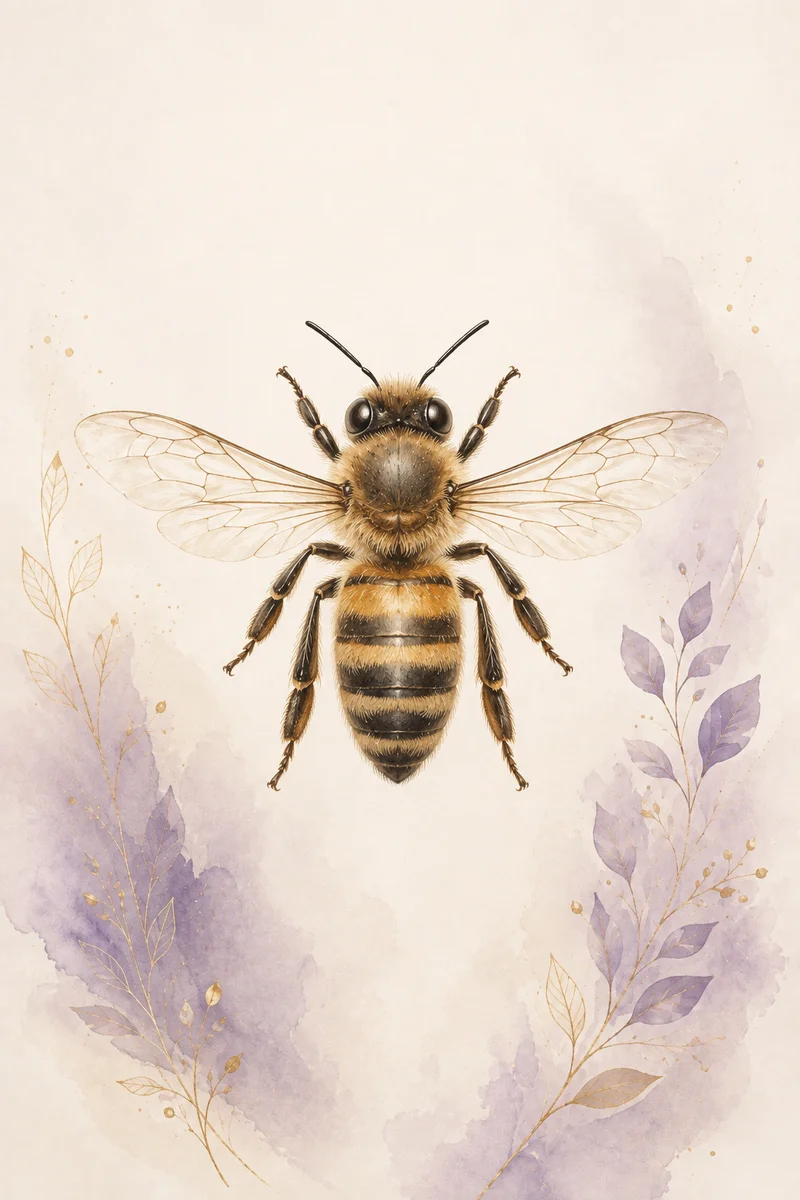
~7 min read
What does one bee actually contribute, inside a colony of tens of thousands? More than nothing, and less than everything — each bee holds a specific role, communicates real information the group depends on, and stays distinct even while working entirely in service of something larger than itself.
Bee energy sits right at that intersection: real individuality, spent in service of a shared whole.
Individual Within the Whole
Shared Purpose
Communication
Over-Giving
Feeling Interchangeable
Bee Spirit Animal — What the Bee Means
Bee symbolism is a very specific kind of contribution — one that only means something because it comes from a distinct individual, not an interchangeable unit. Its power lies in what it actively brings to something larger than itself: a skill, a role, a piece of information the group needs.
That shows up as real devotion drawn from being part of something bigger, active communication of what it finds or knows back to the group, and — underneath — a quiet, recurring question of how much of itself is still its own once it’s given so much away.
Real Bee Behavior Behind the Symbol
Honeybees live in highly organized colonies where each worker’s role — nurse, builder, forager, guard — shifts over the course of its life. Individuals communicate precise information, such as a food source’s direction and distance, back to the group through the waggle dance: a specific form of contribution, not an anonymous one.
A single colony functions as a superorganism: individual bees are relatively short-lived, but through constant division of labor and communication the hive as a whole persists and adapts. Colony survival depends on the accurate, specific contribution of many individuals rather than any one bee acting alone — and pollination, a byproduct of ordinary foraging, ends up sustaining a much wider ecosystem beyond the hive itself.
Sources on the real behavior behind this symbol: biorxiv.org, nature.com. Full methodology and all 64 animals: see our methodology and sources.
Light and Shadow
At its healthiest, bee energy contributes fully to something larger while keeping a real, distinct sense of its own identity — devoted, not dissolved. The shadow side is quieter: folding so completely into a collective role that its own individual shape goes quiet, its needs answered only by whatever the group has left over.
Worth naming clearly: this isn’t a “hive-mind” loss of self — individual bees hold distinct roles and communicate specific information, they aren’t interchangeable — and contribution doesn’t always require self-sacrifice, nor does wanting individual recognition inside a group make that wanting selfish.
Bee Energy in Love, Career, and Growth
In love, this often shows up as devotion expressed through active contribution to a shared life — worth watching for the point where its own individual needs get lost inside the shared “we.”
In career, it tends to thrive in a role where its individual skill visibly serves a clear, shared purpose, though its identity can flatten into “just a function” of the team if that’s not actively resisted.
In personal growth, it often points toward keeping a private reserve of energy and identity — something that belongs to itself, not just whatever’s left after giving to the group.
The Inner Conflict — and Today’s Impulse
Bee energy carries a lasting pull between individuality and the collective: its contribution only means something because a distinct individual gives it, yet the more fully it devotes itself to something larger, the easier it becomes to lose track of its own separate shape. A constructive response isn’t withholding its effort to protect its identity — it’s contributing fully while keeping at least one part of itself that belongs to no one else.
What tends to help most isn’t less devotion — it’s a group or purpose that values what it specifically brings, not just its output, and genuine recognition that its contribution is seen, not just absorbed.
💭 How much of yourself have you folded into something larger, and was that a real choice?
Belonging to something larger was never meant to erase the one who joined it.
Frequently Asked Questions
Is the bee my spirit animal?
Think of the bee as a possible mirror for contribution, identity and belonging, rather than a title you carry forever. Spirit animal and power animal mean the same here: an animal whose qualities echo a theme in your life today. Honeybees share useful information with the colony through the waggle dance. The Spirit Animal Quiz can show how close it feels today.
Does the bee power animal mean I’ll lose my individuality in a group?
Not primarily. Individual bees hold distinct roles and communicate specific information — they aren’t interchangeable. Bee symbolism is about contributing fully while still keeping a real, separate sense of identity.
What’s the difference between the bee and the ant as power animals?
Ant symbolism centers on enduring through many small, repeated actions. Bee’s core tension is different: weighing its own individuality against its role in the collective, not just the effort itself.
Can bee energy show up during a period of feeling burned out from giving too much?
Yes — often as a prompt to ask what’s actually yours versus what you’ve given away, not a sign that giving itself was wrong. If that depletion feels chronic, it’s worth talking to someone you trust or a professional, rather than pushing to contribute more.
The idea of a power animal comes from shamanic and animistic traditions found in many cultures, and is widely used today in Neoshamanism.
Symbols tend to mean more in conversation than they do on a page. If the bee is asking something of you, Marie is a good place to find out what.
Related Power Animals
Ant — shares the theme of contribution to something larger, but leans more into the accumulation of small actions and eventual exhaustion, while bee is more about weighing its own individuality against its role in the collective.
Beaver — shares the theme of building something that outlasts the individual, but leans more into initiating and controlling the shape of what gets built, while bee is more about contributing its effort into an existing shared structure it serves.
