
Axolotl Power Animal Meaning: Regeneration, Patience and Staying in Your Own Form
~7 min read
Most amphibians outgrow the water they hatched in. The axolotl usually doesn’t — even as an adult, it keeps its feathery external gills and stays fully aquatic, not because something stalled, but because it follows a different developmental path than most of its relatives.
That single fact reframes what maturity can look like: a completed life that never needed to resemble anyone else’s.
Non-linear recovery
Staying in one’s own form
Patience
Pressure to “move on”
Axolotl Power Animal — What the Axolotl Means
For the axolotl, recovery doesn’t follow the developmental path most other amphibians take — and symbolically, that becomes a quiet, ongoing capacity to recover in its own form, on its own timeline, without needing to prove the recovery real by turning into something else. Its regeneration isn’t a one-time repair; it’s a stable, continuous ability to recover, fully present even when nothing about the outside looks like it’s changing.
People carrying this energy often show real patience with a recovery process that isn’t visible to anyone watching, and a quiet resistance to being rushed toward looking “recovered” before that feels true. Staying recognizably itself through the process, rather than performing transformation for an audience, is not the same thing as being stuck.
Real Axolotl Behavior Behind the Symbol
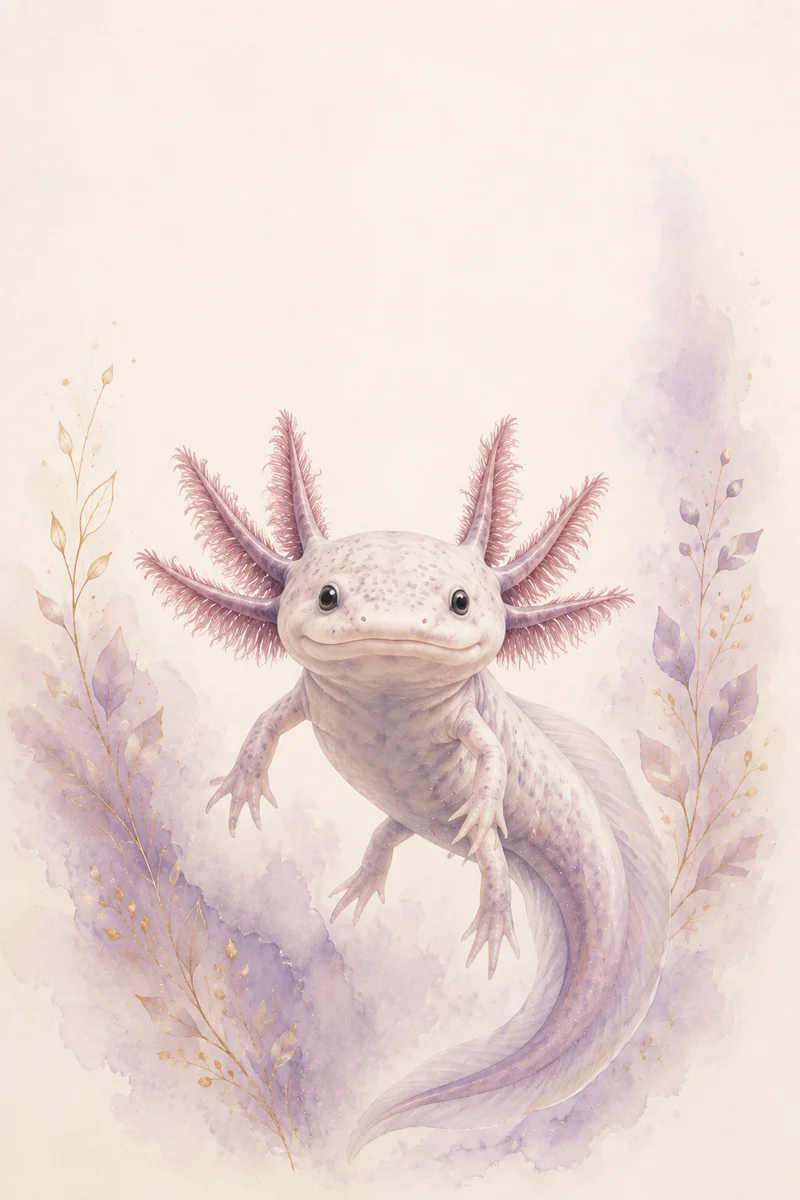
Axolotls are neotenic salamanders — they typically keep their larval features, including external feathery gills and an aquatic body, into full sexual maturity, rather than metamorphosing into a land-based adult form the way most amphibians do. This isn’t developmental delay; it’s a stable, legitimate way of being fully grown.
Their real distinguishing trait is regenerative capacity: axolotls can regrow entire limbs and portions of the spinal cord, heart, and brain tissue, typically without scarring, across their whole lifespan. They’re largely solitary outside of breeding, and historically native to a narrow habitat, Lake Xochimilco in Mexico, where wild populations are now critically endangered.
Sources on the real behavior behind this symbol: nationalgeographic.com. Full methodology and all 64 animals: see our methodology and sources.
Light and Shadow
In its healthy form, axolotl energy symbolizes a recovery that unfolds in its own form and its own time, without needing to visibly transform to prove that anything real is happening underneath. The shadow side is subtler than most: staying in the exact same holding pattern indefinitely, using “recovery at my own pace” as the reason nothing ever actually moves forward.
Worth naming clearly: staying in the same form isn’t being developmentally stuck — neoteny is a stable way of being, not arrested development. This doesn’t always signal crisis, either; it can just as easily describe an ongoing, healthy capacity to recover, even though real recovery still takes real time.
Axolotl Energy in Love, Career, and Growth
In love, this tends to offer real depth once trust is established, on a timeline that doesn’t match anyone else’s expectations — worth watching for staying in a holding pattern rather than risking the vulnerability of visibly changing.
In career, it often does its best work in roles that allow genuine, unrushed recovery, though it can be mistaken for stalled by cultures that only value constant, visible progress.
In personal growth, it tends to point toward trusting a slow, internal process — one that keeps unfolding even on the days it doesn’t look like anything has moved.
The Inner Conflict — and Today’s Impulse
Axolotl energy carries a lasting pull between change and stagnation: its biological regenerative capacity is continuous, but that same regenerative capacity can let it settle into a holding pattern instead of ever fully arriving somewhere new. The point isn’t forcing visible progress on someone else’s schedule — it’s letting recovery keep its own pace, while still watching honestly for the difference between genuine recovery and simply not moving.
What tends to help most isn’t proof of transformation — it’s real patience, from itself as much as from anyone else, and a low-pressure space where recovery can continue quietly, without a deadline attached.
💭 What if your recovery doesn’t need to look like anyone else’s to be real?
Not changing shape is not the same as not recovery.
Frequently Asked Questions
Does the axolotl power animal mean I’m stuck or avoiding growth?
Not necessarily. Staying in one’s own form while recovery internally is a legitimate way of being, not automatic avoidance — the real question is whether change is actually happening underneath, even quietly, or whether nothing is moving at all.
What’s the difference between the axolotl and the lizard as power animals?
Lizard symbolism centers on a discrete rebuild after one specific loss, like a dropped tail. Axolotl’s regeneration is more of an ongoing capacity tied to staying in one continuous form, never needing to leave its shape behind.
Can the axolotl appear when a recovery process has stalled for a long time?
Yes — often as a prompt to check whether something is still genuinely unfolding, or whether the same pace has quietly become an excuse not to move. If a recovery process has stayed static for a very long time, it’s worth naming to a trusted person or a professional, rather than giving it more time alone.
The idea of a power animal comes from shamanic and animistic traditions found in many cultures, and is widely used today in Neoshamanism.
Symbols tend to mean more in conversation than they do on a page. If the axolotl is asking something of you, Marie is a good place to find out what.
Related Power Animals
Lizard — shares the theme of regeneration, but leans more into a discrete rebuild after one specific loss, while axolotl is more about an ongoing capacity for renewal without ever leaving its current form.
Snake — also about renewal, but leans more into shedding an old layer entirely and moving on, while axolotl is more about staying in and quietly refining the same form over time.
