
Gloomy Thoughts – Kipper Card Meaning, Symbolism & Combinations
Kipper cards are part of the German tradition of fortune-telling with cards, closely related to the broader European practice of cartomancy.
The mind sometimes makes more noise than the situation deserves. Gloomy Thoughts shows a phase in which worry, doubt and negative thought patterns dominate — not necessarily because the outer situation is so bleak, but because your inner view has darkened. In the Kipper system this card is the card of mental burden — of brooding, of fears, of thoughts circling without offering rest. It shows an inner state, not necessarily an outer reality. Sometimes the greatest restriction is the one we impose on ourselves. The card asks an important question: how much of what’s weighing on you is really real — and how much is what you imagine in your darker hours? Gloomy Thoughts shows that negative thought patterns, worries, or fears play a central role in the situation. This can point to a specific concern, a phase of low spirits, or a general tendency to expect the worst. The surrounding cards show whether these thoughts are fed by outer circumstances or arise mainly from within. Next to difficult cards it can suggest that the worries have some basis in reality — but not with certainty. Next to positive cards it shows that the thoughts are heavier than the situation itself — the inner burden exceeds the outer one. It’s a reminder that thoughts aren’t facts. What you fear isn’t the same as what is — even when it feels exactly the same in the moment. In love questions, Gloomy Thoughts shows doubt, jealousy, or fear within a connection — inner insecurities that burden the relationship, sometimes more than reality warrants. The question: how much of this is justified — and how much is projection? Professionally, Gloomy Thoughts shows worry about the professional situation — fear of loss, doubt in your own competence, or negative expectations about a development. Sometimes also: a pessimistic mindset that causes you to overlook opportunities. Health interpretations are symbolic only and never replace diagnosis or treatment. Use the card, at most, as a prompt for reflection; seek qualified medical advice for symptoms or concerns. In health questions, Gloomy Thoughts can symbolically stand for mental strain and its effects on overall wellbeing — worries that manifest physically. The card describes the mental state, not a physical diagnosis. Professional advice remains essential. Tendency: Rather no — not because the situation is bad, but because your current mindset is obscuring what’s possible. A shift in perspective could change the picture. How to read these combinations: The examples are symbolic possibilities, not fixed events or facts about other people. Consider the question, context, and verifiable information. Gloomy Thoughts + Great Fortune (26): The worries are bigger than reality — the outer situation is better than the inner perception suggests. Gloomy Thoughts + Hope (36): Even in a phase of gloomy thoughts, hope is present — it just needs to be noticed again. Gloomy Thoughts + A Change (9): A shift in perspective or an outer change lightens the thoughts — movement as an antidote to inner stagnation. Gloomy Thoughts + His Thoughts (16): Intense inner preoccupation with difficult themes — the mind circles around things that weigh heavily. Gloomy Thoughts + Expectation (28): Worried waiting — the uncertainty feeds the negative thought patterns. Gloomy Thoughts + False Person (8): Distrust as the dominant stance — possibly justified, possibly also self-generated. Gloomy Thoughts + Sorrow (32): Mental and emotional burden together — a phase of deep inner darkness. Gloomy Thoughts + Prison (29): Inner and outer being stuck together — thought patterns and outer circumstances reinforce each other. Gloomy Thoughts + Death (19): Heavy thoughts during a time of loss — grief and mental darkness go together. As a card of the day, Gloomy Thoughts invites you to check: how much of what’s occupying your mind right now is really true — and what is fear dressed up as truth? Today is a good day to let go of a thought that doesn’t deserve your energy. Gloomy Thoughts (No.33) shows a phase of negative thought patterns, worry, and inner darkness. The card describes a mental state — not necessarily a bleak outer reality. Sorrow (No.32) shows genuine emotional pain — something hurts. Gloomy Thoughts (No.33) shows mainly mental burden — worry, doubt, brooding. Both can occur together and then reinforce each other. The card invites examination: what is a justified concern — and what is a thought pattern? Sometimes movement, conversation, or a deliberate shift in perspective helps. The surrounding cards show whether outer factors are feeding the inner burden, or whether it arises mainly from within. The meaning above is true for everyone. For you, it only becomes clear with your situation. Tell Marie about it, and she shows you what this card can mean for you. Let these questions work on you — without needing to answer right away.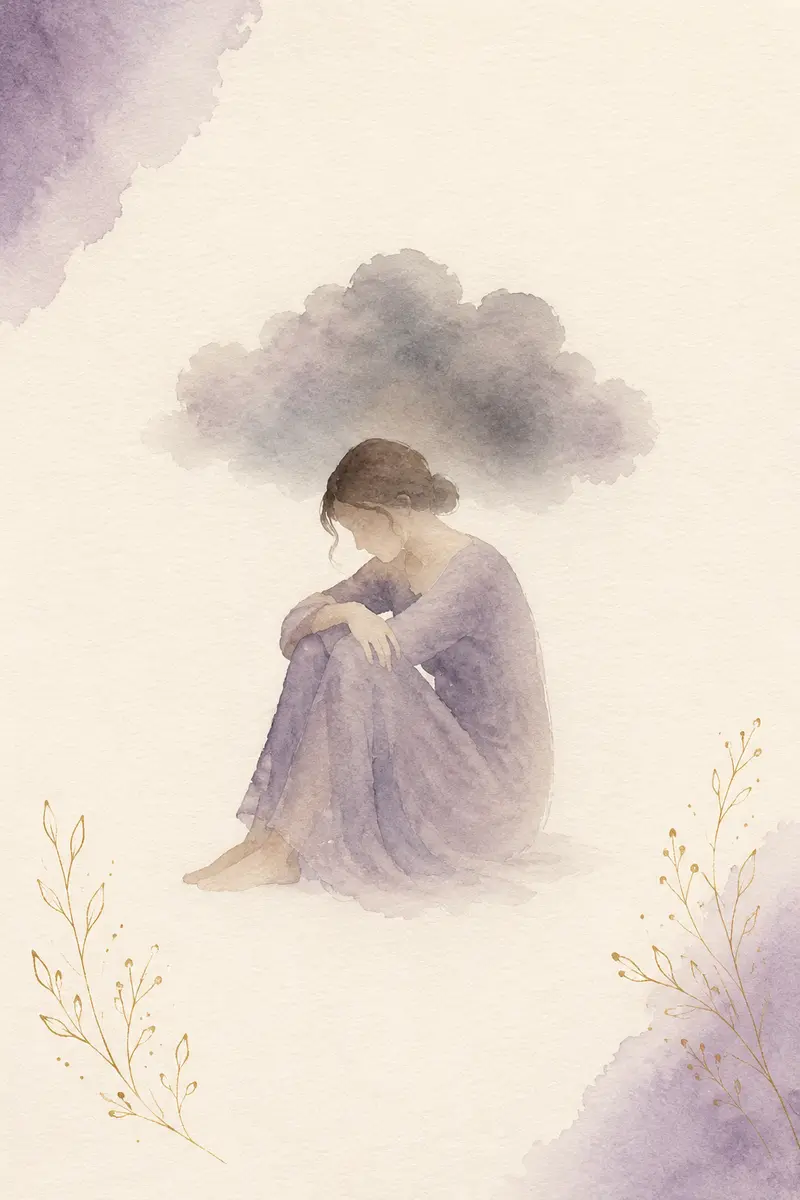
Kipper Card Gloomy Thoughts — The Card’s Image – Symbolism & Meaning
Symbol
Meaning in the Kipper Card
The Darkness
Not physical darkness, but mental — a gaze that no longer perceives the light, even when it’s present.
The Spiral of Thought
Thoughts that repeat and intensify — brooding as an energy vampire that consumes your strength.
The Inner Lens
What you see is coloured by your inner stance — Gloomy Thoughts alters your perception of reality.
The Number 33
Numerologically, thirty-three, a master number, connects with deep inner work — thought patterns as a theme needing profound clarification.
Gloomy Thoughts – General Meaning & Message
Gloomy Thoughts in Life Areas
In Love
In Career & Finances
In Health
Gloomy Thoughts – Yes or No?
Important Combinations with Gloomy Thoughts
Positive Combinations
Neutral / Situational Combinations
Challenging Combinations
Gloomy Thoughts as a Daily Card
Frequently Asked Questions about Gloomy Thoughts
Kipper Card Gloomy Thoughts: What does Gloomy Thoughts mean in the Kipper cards?
What’s the difference between Gloomy Thoughts and Sorrow?
What to do when Gloomy Thoughts appears in a reading?
Reflection Questions
